
For personal trainers
Assisted Stretching for Personal Trainers.
Personal trainers can study assisted stretching as an additional professional skill, but education and certification do not override local laws, professional licensing rules, employer or facility policies, or insurance requirements. A strong assisted-stretching education teaches safety, professional boundaries, client communication, practitioner body mechanics and controlled technique — not just a collection of stretches.
Trainers ask two different questions about this subject and they get mixed together constantly. The first is can I learn it, and the answer is yes. The second is am I allowed to offer it, and that one is not answered by any course, any certificate or any page on the internet — including this one.
This guide separates them. It explains what assisted stretching actually is, what a trainer needs to learn to deliver it safely, why the hands-on part cannot be skipped, how ASA’s pathway works, and exactly which requirements decide what any individual practitioner may offer.
Explore Assisted Stretching Certification · View ASA Certification
- Professional education
- Scope and boundaries
- Hands-on training
- Practitioner mechanics
- Practical competency
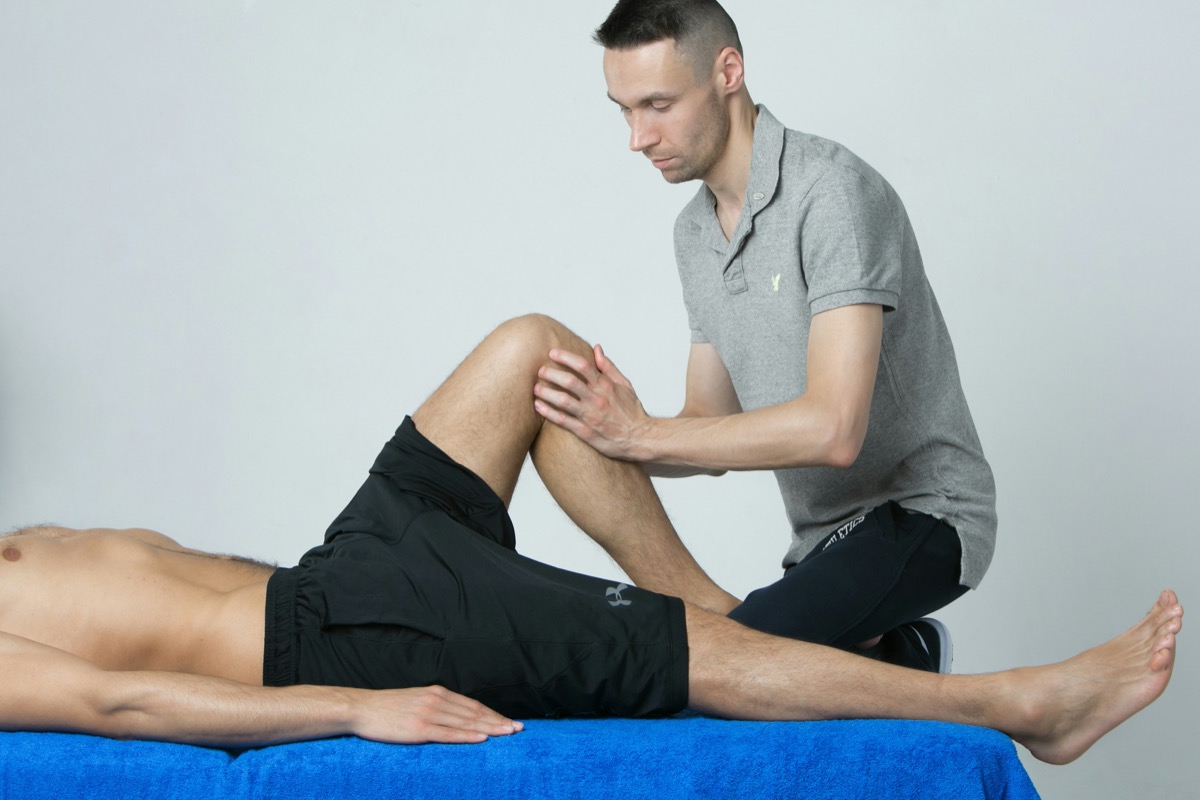
A different skill, next to the one you have.
The client stays passive. The practitioner controls the movement.
The motivation
Why Personal Trainers Look at Assisted Stretching.
Trainers come to this subject for professional reasons, and they are worth stating plainly rather than dressed up as an opportunity.
A skill set that is genuinely adjacent
A trainer already understands movement, already works one-to-one, and already coaches people through unfamiliar positions. Assisted stretching sits next to that work rather than replacing it, so the learning curve is about the hands-on components rather than about starting from nothing.
More variety inside a session
Trainers who study this properly tend to describe the same benefit: another set of tools for the parts of a session that were previously improvised — warm-up, cool-down, and the positions where a client needs support rather than instruction.
Flexibility and mobility work, done deliberately
Flexibility and mobility are ordinary fitness objectives, and clients raise them constantly. Structured education replaces guesswork with a method — how to position, how much leverage to apply, how to read what is happening, and when to stop.
A distinct service, where that is appropriate
Some practitioners keep assisted stretching inside their existing sessions. Others offer it as a separate appointment with its own structure and its own client expectations. Which of those is appropriate depends on the requirements that apply to that practitioner, in that setting.
Another reason for a client to come in
A second service is a second occasion to work with someone, and it can suit clients who are managing training load or who simply want a session that is not a workout. It is a professional offering, not a growth mechanism, and no page can tell a trainer how their own clients will respond to it.
Longer professional relationships
Practitioners often want to stay useful to a client across years rather than months. Broadening what you are trained to deliver well is one legitimate way to do that. It is not a guarantee of anything, and this page makes none.
These are reasons professionals give for studying the subject. They are not outcomes ASA promises, measures or can influence: ASA provides education and certification, and it does not provide clients, referrals, employment or income. Whether a trainer can offer assisted stretching at all — and in what form — is decided by the requirements set out further down this page, not by completing a course.
The definition
What Is Assisted Stretching?
Assisted stretching is practitioner-guided stretching: a trained practitioner positions, supports and moves a client through a stretch while the client stays relatively passive, controlling the range, the leverage and the pace, and adjusting continuously based on what the client reports and what the practitioner can feel. It is delivered as a non-medical professional service, usually on a stretch or treatment table, in a session structured around communication and control rather than around effort.
The same subject is searched under several names. "Stretch therapy certification", "stretch therapist certification" and "stretch practitioner certification" are all common search terms for this field, and trainers use them interchangeably. They are search terminology rather than titles: ASA issues one practitioner credential, the ASA Certified Stretch Practitioner, and nothing about the words a person searched changes what any credential permits.
For the full explanation written for clients as much as for practitioners, see what assisted stretching is: the components of a session, what it should feel like, and where it sits alongside massage and physical therapy.
It is not massage
Assisted stretching is a distinct discipline and ASA does not teach it or describe it as massage. Massage therapy is a separately regulated profession in many places, with its own licensing requirements, its own title protections and its own scope. Where those requirements exist they apply regardless of what a service is called.
It is not physical therapy
Physical therapy is a licensed healthcare profession. Assisted stretching as ASA teaches it is not healthcare, is not delivered as part of a clinical care plan, and is no substitute for one. A practitioner who believes a client needs clinical attention refers rather than improvises.
It is not medical treatment
ASA does not teach practitioners to diagnose a condition, to treat one, or to make any health claim about what a stretch will do for a person. The service is delivered inside a non-medical scope, and the education spends real time on where that scope ends.
It is not assessment or clearance
Nothing in an assisted-stretching session evaluates whether a client is medically fit for anything. Practitioners screen for the purpose of delivering a session safely and knowing when not to — which is not the same as clearing someone, and is never presented as such.
Reading this as a massage therapist rather than a personal trainer? The companion guide is assisted stretching for massage therapists, which answers the same questions for a profession that is licensed in many places.
The question everyone arrives with
Can Personal Trainers Offer Assisted Stretching?
Whether a personal trainer may offer assisted stretching depends on where they work and what exactly they are offering. It is decided by applicable state, provincial or national law; by any professional licensing rules that already apply to them; by their employer’s and their facility’s policies; by whether their liability insurance actually covers the service; and by the nature of the service itself. Certification is not one of the things that decides it.
That is not a hedge, and it is not a way of avoiding the question. Requirements around hands-on work vary meaningfully between jurisdictions and between employers, and they turn on details — how the service is described, where it is delivered, what is charged for it, and what other credential the practitioner already holds. A web page cannot know any of those things about a particular reader, and any page that answers this question with a flat yes is answering a question it was not in a position to ask.
What a certification does not change:
- State, provincial or national law, including any title or practice restriction
- The rules of any licensing board the reader is already regulated by
- Employer and facility policy, which is often stricter than the law
- Professional liability insurance, which has to actually cover the service being offered
Questions worth answering before the first session
Each of these has an authoritative source, and none of them is this page. Take them to the party who can actually answer them, and get the answer on record.
What does the law where I work actually permit?
Rules governing hands-on services, protected titles and regulated practices are set locally and differ. The authoritative answer comes from the relevant regulator or licensing authority in your jurisdiction, or from your own professional adviser — not from an education provider, and not from this page.
Does a credential I already hold restrict or condition this?
A trainer who is also licensed or registered in another profession may be bound by that board’s rules on what they may offer, how they may describe it, and under what title. Those rules keep applying after any additional certification.
Does my employer or facility allow it?
Employer and facility policy is frequently stricter than the law, and it is the requirement most often discovered last. Ask before the first session, in writing, and ask specifically about hands-on work rather than about "stretching" in general.
Does my liability insurance cover this service?
A policy written for personal training does not automatically extend to a different service. The question for the insurer or broker is whether this specific activity, as delivered and as described to clients, is covered — and the answer needs to be on record.
Am I staying inside a non-medical scope?
Assisted stretching as ASA teaches it does not diagnose, does not treat and makes no health claim. A service that drifts toward any of those has stopped being the thing this education prepares a practitioner to deliver, whatever it is still called.
ASA makes no state-specific legal determination for any reader, and nothing on this page should be read as legal advice or as confirmation that a particular trainer may offer a particular service in a particular place.
Certification does not establish legal scope of practice
Certification does not determine a practitioner’s legal scope of practice. Laws, professional licensing requirements, title restrictions, insurance conditions and facility policies vary by state, by country and by employer, and they apply to a certified practitioner exactly as they applied before. Anyone entering this field is responsible for confirming what they are permitted to do where they intend to work, and for consulting the appropriate licensing authority or their own professional adviser where that is unclear.
Overlap and difference
Assisted Stretching vs Personal Training.
The overlap is real and it is why trainers pick this up quickly: both are one-to-one, both depend on understanding movement, and both live or die on how well the professional communicates. The difference is who is producing the movement. In training the client moves and the trainer coaches; in assisted stretching the practitioner moves the client and the client reports back. That reversal is the whole of the new skill, and it is the reason watching a technique is not the same as being able to perform it safely.
Personal training typically centres on
- Programming exercise toward a training objective
- Strength, conditioning and general fitness instruction
- Coaching a client through movement the client performs
- Load, progression and technique correction over time
- Cueing, demonstration and verbal instruction as primary tools
Assisted stretching typically centres on
- Practitioner-guided stretching the practitioner controls
- Positioning, support and stability for a relatively passive client
- Leverage, range and pace, adjusted continuously
- Contact and feedback as primary tools alongside communication
- Session structure built around control and safe return to neutral
These are descriptions of where each kind of work usually centres, not legal definitions. What any individual is permitted to do under either heading varies by jurisdiction, by licence, by employer and by insurer.
The full comparison — assisted stretching vs personal training — covers what happens in each kind of session, who is doing the movement and why that is not the whole answer, where hands-on contact fits, and what a certification does and does not settle.
The professional checklist
What a Personal Trainer Needs to Learn.
Twelve things, and a program that covers the techniques without covering these is teaching the visible half of the skill. This list is written to be carried to any provider and asked about — including this one.
Scope and professional boundaries
- Where this service ends, what it never claims to do, and how to describe it to a client accurately. This belongs first because every other item depends on it.
Client screening
- What to ask before a first session, what answers mean a session should be modified, and what answers mean a practitioner declines and refers. Screening for safe delivery — not assessment, and not clearance.
Communication that works during contact
- Consent, explanation, permission before the hands go on, and a continuous exchange during the stretch. A client who does not know what is about to happen cannot give useful feedback about it.
Support and positioning
- How a client is set up on the table, what is supported, what is stabilised, and what is left free to move. Most of the safety in a stretch is decided before it starts.
Practitioner body mechanics
- Stance, base, distance from the table and use of body weight rather than arm strength. This protects the practitioner, and a practitioner who is straining cannot control what they are doing to someone else.
Leverage
- Understanding how much force a given position actually produces. Long levers multiply small movements, which is the mechanism behind most of the ways a stretch goes further than intended.
Intensity management
- Working at a level the client can breathe and talk through, rather than at the edge of what they can tolerate. Reading intensity through contact, not only through what is said.
Safe return to neutral
- The exit is part of the technique. Coming out of a position with the same control used to enter it is a taught skill, and it is one of the things a practical assessment looks for.
Appropriate technique selection
- Choosing what fits this client, in this session, at this point in the session — rather than running a fixed sequence because it is the one that was learned.
Session structure
- How a session opens, progresses, transitions between positions and closes, so the whole thing is coherent rather than a series of unrelated stretches.
Documentation and client experience
- What is recorded, what a client is told, and the professional standard of the room, the table and the interaction. Practitioners are responsible for their own record-keeping and for meeting any requirement that applies to them.
When to modify and when to stop
- The judgement that separates a trained practitioner from someone copying a technique: recognising the moment to change what you are doing, and the moment to end the stretch and refer.
How to evaluate any program against a list like this:Read the assisted stretching certification guide
What that adds up to in practice — the responsibilities of a session, the skills the role asks for and the professional boundaries around it — is set out in what a stretch practitioner does.
The physical skill
Why Hands-On Training Matters.
Watching a stretch is not the same as performing it safely.
Assisted stretching is a practitioner-to-client skill. One person moves, supports and controls another person’s limb while reading how that person is responding. Everything in that sentence is physical, and none of it can be verified by a test taken alone at a keyboard — which is a different situation from most of what a trainer has certified in before.
- Hand placement. Where the hands go decides what is supported, what is moved and what is protected. It is a matter of centimetres and it is corrected by someone watching, not by a video.
- Table positioning. Height, approach and where the practitioner stands relative to the client determine whether a technique is controllable at all.
- Practitioner stance. A stable base is what allows a practitioner to move a limb smoothly and to stop instantly. Trainers are used to being the one who moves; standing still and controlling someone else is a different physical habit.
- Client support. A supported client can relax, and a relaxed client is the only kind assisted stretching works on. Support is a skill, not a byproduct of good intentions.
- Communication under contact. Asking the right question at the right moment, and hearing the answer while your hands are occupied. This is practised, not read.
- Leverage and control. Applying enough to be useful and never more than intended — then reversing it under the same control. The margin is smaller than it looks from the outside.
- Reading feedback. What resistance feels like, what a guarded muscle feels like, and what a client’s breathing is telling you. None of it is available through a screen.
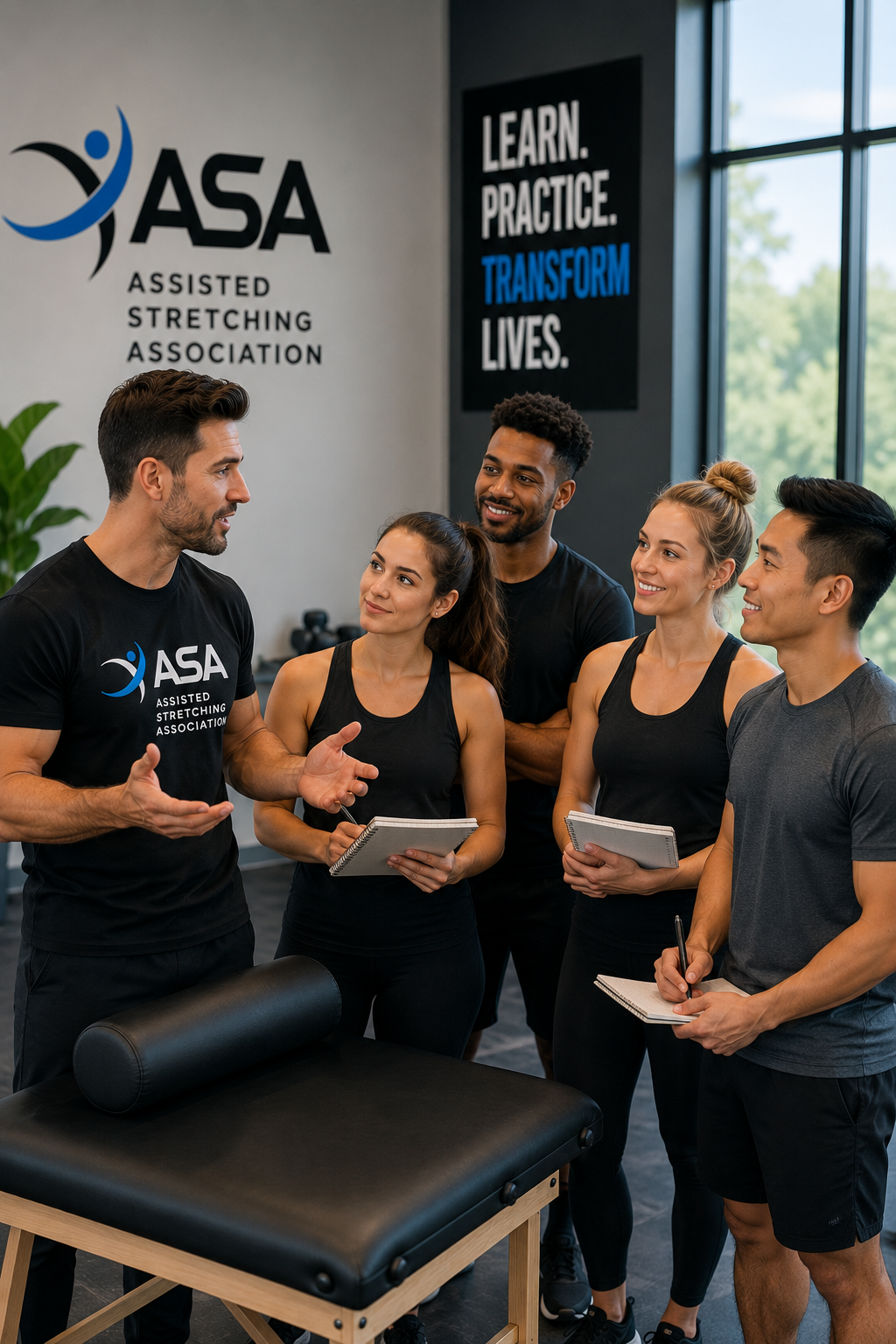
This is why ASA does not certify practitioners on written work alone. The knowledge can be taught online and is; the physical skill is developed in person and demonstrated in front of someone qualified to judge it.
How ASA does it
How ASA Trains Personal Trainers.
The order is not arbitrary. Education does not verify skill and a written exam does not verify hands, so the credential sits after the two stages that check the things the earlier ones cannot.
- Fast Track Essentials
- Knowledge Assessments
- Hands-On Training
- Practical Competency
- ASA Certified Stretch Practitioner
- 01
ASA Fast Track Essentials
- Required pre-class readiness education.
- Currently six short online modules, completed before class: the professional standard, safety, intake and client readiness, applied anatomy with communication and consent, body mechanics, and building a session. It exists so that a student walks into the hands-on environment already knowing the vocabulary, the safety expectations and the professional standard of the room, rather than spending the first hours of a training day on ground that could have been covered beforehand.
- Fast Track Essentials is preparation. It is not certification, and completing it does not issue any credential.
- 02
Knowledge assessments
- Assessments that can genuinely be failed.
- An online assessment before class, requiring 80% with every safety question answered correctly. Passing it means a student is ready for class; it issues no credential.
- 03
One-day hands-on certification training
- The part that cannot be delivered through a screen.
- One full day in person, learning ASA's signature 25-minute and 50-minute routines: client positioning and setup, support, practitioner stance and body mechanics, leverage, communication, range and control, transitions between positions, and safe return to neutral — practised on real people with an instructor watching and correcting.
- 04
Practical competency
- Demonstrating the skill, not describing it.
- A practical requirement administered in person by an instructor. Every practical record is reviewed by a person — nothing is issued automatically on a passing score.
- 05
ASA Certified Stretch Practitioner
- The credential, and it comes last on purpose.
- Awarded when the education, the hands-on training, the assessments and the practical competency requirement are all complete and the record has been reviewed and approved. It documents completed education and demonstrated competency. It does not decide what a practitioner is legally permitted to do.
See How ASA Certification Works
Service models
Can a Trainer Add Assisted Stretching as a Separate Service?
Practitioners structure this several ways. What follows is a description of the options so a reader can think about them clearly — it is not a statement that any particular option is available to any particular practitioner.
Inside existing sessions
Assisted stretching used within training sessions a practitioner already delivers, where that is consistent with the requirements that apply to them and with what the client agreed to.
Dedicated appointments
A separate appointment type with its own structure, its own length and its own client expectations, booked as assisted stretching rather than as training.
Operating inside a gym
Delivered in an appropriate space within a facility, under whatever arrangement that facility agrees to — employment, contract, rental or something else entirely.
Wellness partnerships
Working alongside other professionals in a wellness, recovery or multi-disciplinary setting, with the boundaries between services made explicit rather than assumed.
A private studio room
A dedicated professional room, whether rented, shared or owned, set up for this service specifically.
Independent practice
An independent assisted-stretching practice, operated as its own business with its own obligations, insurance and records.
These are shapes a practice can take, described so a reader can think clearly about the options. None of them is an approval: whether a particular model is available to a particular practitioner is decided by law, licensing rules, employer and facility policy and insurance, exactly as set out above. ASA publishes no pricing guidance, no revenue expectation and no earnings figure for any of them, and it does not provide clients, referrals, employment or income.
The environment
Assisted Stretching Inside a Gym.
A gym is a plausible setting for this work and a difficult one to improvise in. These are the things that have to be settled before a first session rather than discovered during one.
- An appropriate space. A designated area with enough room to work around a table on all sides, and a level of privacy appropriate to a hands-on service. A corner of the gym floor is rarely either.
- Facility approval, in writing. Explicit agreement from whoever runs the facility that this specific service may be delivered there, on what terms, and under whose insurance. Verbal permission from a shift manager is not this.
- Clear service boundaries. Members need to understand what is being offered and what is not. A service described loosely inside a busy facility is the fastest route to a client expecting something the practitioner does not provide.
- A professional client experience. Clean linens, a proper intake conversation, a consistent session structure and a practitioner who is not being interrupted. The standard is the same whether the room is inside a gym or not.
- Scheduling that actually works. A booking arrangement the facility supports, with enough time between sessions to reset the space and to write anything down.
- Insurance and permission that match. Cover that names this activity, held by whoever the facility requires to hold it. This is a question for the insurer and the facility together, before the first session.
- Proper equipment. A professional table appropriate to the work, and the supports and supplies that go with it. See the equipment section below.
Reading this as the owner, manager or fitness director rather than as the practitioner? The companion guide is assisted stretching for gyms and fitness facilities, which covers staffing, standards, consent, scope and what changes across multiple locations.
A room inside a facility, as a developing pathway
ASA is developing the STRRRETCH – Maximum Performance Facility Partner Studio Pathway: a model for qualified practitioners to build an assisted-stretching practice from one professional room inside an existing gym, wellness or chiropractic facility rather than from a full retail storefront. It is still in development, nothing about it is offered for sale, and certification and business participation are separate.
Explore the Business PathwayProgram in Development
Setting up
What Equipment Might a Trainer Need?
Less than most people expect. This is a skill-led service, not an equipment-led one, and the list below is close to complete.
A professional stretch or treatment table
Stable, rated for the work, and at a height that lets the practitioner use body weight rather than arms. This is the one item worth being particular about.
Clean supports and bolsters
Used where a position needs them, to support the client rather than to add range.
Sanitation supplies
Linens, cleaning materials and a routine for turning the space over between clients, meeting whatever standard the facility or jurisdiction requires.
Client forms and resources
Intake, consent and session records appropriate to the practice and to any requirement that applies to it. Practitioners are responsible for their own documentation.
A professional space
Room to work around the table, a clean surface, and privacy appropriate to hands-on work.
A scheduling and client-management system
Whatever the practitioner or business chooses. ASA does not supply, resell or require a booking system, and it endorses no vendor.
That is the list. Assisted stretching does not require an expensive equipment build-out, and a program that implies otherwise is describing a purchase rather than a practice.
Formal education
Assisted Stretching Certification for Personal Trainers.
Four reasons trainers pursue formal education in this specifically, rather than adding techniques to what they already do.
A personal-training certification is not assisted-stretching education
It is a credential in a different subject. The hands-on components in particular — support, positioning, leverage, control and reading feedback through contact — are not covered by a training certification, and they are the part that carries the risk.
Structured education beats assembled clips
Technique learned from scattered sources arrives without the safety reasoning, the screening, the boundaries or the progression that made it safe in the first place. A structured program teaches those as subjects rather than as asides.
Competency someone else has verified
A practical requirement means a qualified person watched the work and judged it — which is a different kind of evidence from a completion certificate, and the kind that matters when a facility or an insurer asks what your preparation was.
A record you can point to
Certification documents what was studied and what was demonstrated. Employers, facilities and insurers frequently ask for exactly that. What they do with it is their decision, and ASA makes no representation about how any particular organisation will weigh it.
ASA certification is not legally required to work in fitness, and this page does not claim that it is. It is professional education leading to a credential, and whether any credential is required — or sufficient — for a particular service in a particular place is set by that place, not by ASA.
Explore Assisted Stretching Certification · View ASA Certification
Step by step, what it takes: how to become a stretch practitioner — the education, the hands-on training, the practical competency, and the professional requirements a certification does not settle.
The distinction that matters most
Certification vs Scope of Practice.
Certification documents education and competency. It does not write the law.
The ASA Certified Stretch Practitioner credential demonstrates completion of ASA’s educational and competency pathway. That is a real thing and it is worth holding. It is also, precisely, all that it is.
What ASA certification documents
- Records that a named practitioner completed a defined program of professional instruction
- Records that they met the assessment standard that program set
- Records that they demonstrated the physical skill in front of someone qualified to judge it
- Gives an employer, a facility or an insurer something specific to evaluate
What it does not replace
- A licence, a registration or a protected professional title
- State, provincial or national law, or any title or practice restriction it contains
- The rules of any licensing board a practitioner is already regulated by
- Employer and facility policy, which is frequently stricter than the law
- Professional liability insurance, or the terms of any policy
- It confers no authorisation to assess, diagnose or treat any condition
Certification does not determine legal scope of practice
Certification does not determine a practitioner’s legal scope of practice. Laws, professional licensing requirements, title restrictions, insurance conditions and facility policies vary by state, by country and by employer, and they apply to a certified practitioner exactly as they applied before. Anyone entering this field is responsible for confirming what they are permitted to do where they intend to work, and for consulting the appropriate licensing authority or their own professional adviser where that is unclear.
Read ASA’s full stretch practitioner scope of practice guide — what the role includes, what sits outside it, and when to modify, stop or refer.
What comes next
Business Pathways for Personal Trainers.
A credential is a starting point rather than a destination. These are directions certified practitioners take — what any individual is able to offer, and where, depends on the requirements that apply to them.
Add it to an existing business
Incorporate assisted stretching into a training practice that already exists, where that is appropriate for the practitioner and the setting.
Offer standalone appointments
Run assisted stretching as its own service with its own booking, alongside or instead of training work.
Work inside another professional facility
Deliver the service in a gym, wellness, recovery or chiropractic setting under an arrangement that facility agrees to.
Rent a professional room
Take a dedicated room, alone or shared, and operate independently from it.
Build a dedicated stretch practice
Develop assisted stretching as the primary business rather than as an addition to one.
Explore the developing partner studio pathway
ASA is developing a business pathway for qualified practitioners built around one professional room inside an existing facility. It is in development and nothing about it is offered for sale today.
These are possibilities, not outcomes. ASA educates and certifies; it does not provide employment, clients, referrals or income, it guarantees no business result, and it publishes no earnings figure. What any practitioner is able to offer, and where, depends on the requirements that apply to them.
Explore the Business PathwayProgram in Development
Learn from these instead
Common Mistakes When Trainers Add Assisted Stretching.
Most of these are what happens when a physical skill is picked up from material that was never built to teach it. They are listed with what to do instead, because a list of failures on its own is not education.
Treating certification as legal permission
- The most consequential one, and the reason it is first. A credential is evidence of education; it is not authorisation.
- InsteadSettle the permission question separately, with the regulator, the employer, the facility and the insurer, before the first paid session.
Using too much force
- Usually not deliberate. It comes from long levers, from a stance that cannot modulate, and from a client who is being polite about it.
- InsteadWork at an intensity the client can breathe and talk through, and read their silence as a reason to check rather than as consent.
Chasing range
- Range is easy to see and easy to measure, so it becomes the goal by default. It is not the goal, and pursuing it is how a session stops being controlled.
- InsteadWork the position properly and let range be a byproduct of a well-executed stretch.
Poor practitioner body mechanics
- Reaching, twisting, working at the wrong table height or pulling with the arms. It wears the practitioner out and it removes the fine control the technique depends on.
- InsteadSet the table height, take a stable base, and move from the legs and body weight.
Weak communication
- Going quiet during the stretch. A client who does not know what is coming cannot tell you anything useful about it.
- InsteadExplain, ask permission, and keep a short exchange running through the position.
Unclear service boundaries
- Describing the service loosely, or letting a client believe it is something adjacent that it is not.
- InsteadSay what the service is and what it is not, in the same words every time, and refer when a client needs something else.
Failing to support the client
- An unsupported limb or an unstable position means the client cannot relax, and a client who is bracing is being stretched against their own resistance.
- InsteadSet the position up so the client is fully supported before any range is taken.
Copying techniques without structured education
- A technique learned in isolation arrives without the screening, the contraindications and the reasoning that made it appropriate for the person it was demonstrated on.
- InsteadLearn the principles that generate the techniques, then the techniques.
Not planning the return to neutral
- The exit is a taught part of the technique and it is the part most often improvised. Coming out fast undoes the control the whole position was built on.
- InsteadRehearse the exit as deliberately as the entry, and never release a position abruptly.
Marketing with claims outside scope
- Language about conditions, clinical outcomes or health benefits turns a non-medical service into a claim the practitioner cannot support.
- InsteadDescribe the service accurately, make no health claim, and let the work be the description.
Before the first session
Questions to Ask Before Offering Assisted Stretching.
Eight questions a trainer answers for themselves. Deliberately not answered here — the value of this list is that it is portable, and a page that supplied the answers would be supplying answers it cannot have.
Do I understand my own professional scope?
- Including any restriction that comes with a credential you already hold, and any title protection that applies where you work.
Does my insurance cover this specific service?
- Confirmed with the insurer or broker, for this activity as actually delivered and as actually described — and on record.
Does my facility permit it?
- In writing, from someone with authority to give it, and specifically about hands-on work.
Have I had structured hands-on training?
- Practised on real people with a qualified person correcting the work — not assembled from video.
Can I explain the service accurately?
- In plain language, including what it is not, without drifting toward a claim you cannot support.
Do I have appropriate client documentation?
- Intake, consent and session records suited to the practice and to any requirement that applies to it.
Do I know when to stop, modify or refer?
- Decided before the session rather than in the middle of one, and practised until it is a reflex.
Am I making only claims I can actually support?
- In how the service is marketed, priced and described — and in what a client is told to expect from it.
Questions
Assisted Stretching for Personal Trainers: FAQ.
Can personal trainers learn assisted stretching?
Yes. Personal trainers can study assisted stretching as an additional professional skill, and many of ASA’s students come from exactly that background. Trainers already understand movement and already work one-to-one; what is genuinely new is the hands-on work — supporting and positioning another person, controlling leverage, and reading feedback through contact rather than through observation.
Can personal trainers offer assisted stretching?
It depends, and not on certification. Whether a personal trainer may offer assisted stretching is decided by applicable state, provincial or national law, by any professional licensing rules that already apply to them, by their employer’s and facility’s policies, by whether their liability insurance covers the service, and by the nature of the service being provided. ASA makes no state-specific legal determination and nothing on this page is legal advice.
Do personal trainers need assisted stretching certification?
A personal-training certification is education in a different subject, so a trainer who wants to deliver assisted stretching as a professional service generally does need dedicated instruction — particularly in the hands-on components, which are the part that cannot be learned from a screen. Whether any credential is required, or sufficient, for a particular service in a particular place is set by that jurisdiction, that employer and that insurer rather than by an education provider.
Does ASA certification expand my legal scope of practice?
Certification does not determine a practitioner’s legal scope of practice. Laws, professional licensing requirements, title restrictions, insurance conditions and facility policies vary by state, by country and by employer, and they apply to a certified practitioner exactly as they applied before. Anyone entering this field is responsible for confirming what they are permitted to do where they intend to work, and for consulting the appropriate licensing authority or their own professional adviser where that is unclear.
Is assisted stretching the same as massage?
No. Assisted stretching is a distinct discipline and ASA does not teach it or describe it as massage. Massage therapy is a separately regulated profession in many places, with its own licensing requirements, title protections and scope, and those requirements apply wherever they exist regardless of what a service is called.
Is assisted stretching the same as physical therapy?
No. Physical therapy is a licensed healthcare profession. Assisted stretching as ASA teaches it is a non-medical service: it does not diagnose, it does not treat, it makes no health claim, and it is no substitute for clinical care. Practitioners are taught to refer when a client needs something outside that boundary.
Can a personal trainer offer standalone assisted-stretching sessions?
Some practitioners deliver assisted stretching as a separate appointment with its own structure rather than inside a training session. Whether that model is available to a particular trainer depends on the same things as everything else on this subject: local law, any licensing rules that apply to them, employer and facility policy, and insurance that actually covers the service as delivered.
Can I provide assisted stretching inside a gym?
Only where the facility permits it and the other requirements are met. In practice that means an appropriate designated space with room to work around a table, written approval from the facility, insurance that names the activity, clear service boundaries so members understand what is offered, and a professional standard of client experience. Facility policy is frequently stricter than the law and should be settled before a first session.
What should a personal trainer learn before stretching clients?
Scope and professional boundaries, client screening, communication and consent, support and positioning, practitioner body mechanics, leverage, intensity management, safe return to neutral, appropriate technique selection, session structure, documentation and client experience, and when to modify, stop or refer. A program that teaches techniques without those is teaching the visible half of the skill.
Does ASA include hands-on training?
Yes. The ASA pathway includes a one-day in-person hands-on certification training covering client positioning and setup, support, practitioner stance and body mechanics, leverage, communication, range and control, transitions, and safe return to neutral — followed by a practical competency requirement administered by an instructor.
Can ASA certification be completed entirely online?
No. ASA's preparation is delivered online, but the certification pathway also requires a one-day in-person hands-on training and a practical competency requirement. Assisted stretching is a physical, practitioner-to-client skill, and ASA does not certify it on written work alone.
What credential does ASA issue?
ASA issues one practitioner credential: the ASA Certified Stretch Practitioner. Phrases such as "stretch therapy certification" and "stretch therapist certification" are common search terms for this subject, but they are not the name of ASA's credential.
How much does ASA certification cost?
Standard tuition is $797. ASA currently offers $497 early tuition to students who enroll by the early-enrollment date shown for their class, and $597 final-week tuition during the seven days before class. Current class dates, pricing and enrolment details are on the ASA certification page.
How long does the ASA pathway take for a personal trainer?
ASA Fast Track Essentials is required pre-class readiness education — currently six short online modules plus a short online assessment — and the hands-on certification training is one full day. Total time also depends on which class date a student chooses and when the practical requirement is completed and reviewed.
Can personal trainers start an assisted-stretching business?
Practitioners build assisted-stretching practices in several shapes: inside an existing training business, as standalone appointments, within another professional facility, from a rented professional room, or as an independent practice. Whether any of those is available to a particular trainer depends on local law, licensing rules, facility agreements and insurance. ASA educates and certifies; it does not provide employment, clients, referrals or income, and it publishes no earnings figure.
What is the STRRRETCH – Maximum Performance Facility Partner Studio Pathway?
The STRRRETCH – Maximum Performance Facility Partner Studio Pathway is a business pathway ASA is developing for qualified practitioners: a model for running an assisted-stretching practice from one professional room inside an existing gym, wellness or chiropractic facility rather than from a full retail storefront. It is in development and nothing about it is offered for sale today. Program structure, availability, requirements and terms are still being developed. It begins with the ASA Certified Stretch Practitioner credential, and certification and business participation are separate.
The point of all of it
Add the Skill the Right Way.
- Learn the principles.
- Train the technique.
- Demonstrate competency.
- Stay within your professional scope.
Explore Assisted Stretching Certification · View ASA Certification Options
More ASA guides: what assisted stretching is, how certification works, what it costs.