
The practitioner role
What Does a Stretch Practitioner Do?
An assisted stretch practitioner guides clients through practitioner-assisted stretching using positioning, support, controlled movement, communication and range management. The practitioner’s role includes preparing the client, supporting the body through each technique, monitoring feedback, adjusting intensity, maintaining professional boundaries and returning the client safely to neutral.
ASA practitioners do not use the ASA credential to diagnose injuries, provide medical treatment or prescribe rehabilitation.
This guide is written for the person asking whether this is work they could do: someone considering assisted stretching as a career, a personal trainer or massage professional weighing it as an addition to what they already do, or anyone who has had a session and wondered what the practitioner was actually trained to be doing.
It covers what happens before the first stretch, what the practitioner does during one, how intensity and range are managed, when to modify, stop or refer, what happens after, the skills the role asks for, what the ASA credential does and does not authorize, where practitioners work, and the fifteen questions worth being able to answer before working independently with clients.
What it is not is a job advertisement. There are no salary figures on this page, no earnings claims and no promise of employment or clients, because ASA has none to make.
Explore ASA Certification · What Is Assisted Stretching?
This page is general professional education about a role. It is not legal, licensing, insurance, employment or career advice, and it is not a job description for any particular employer. Requirements and duties vary by jurisdiction, workplace and business, and ASA makes no determination for any practitioner and guarantees no employment, clients or income to anyone.
- Positioning and support
- Controlled movement
- Continuous communication
- Professional boundaries
- Non-medical practice
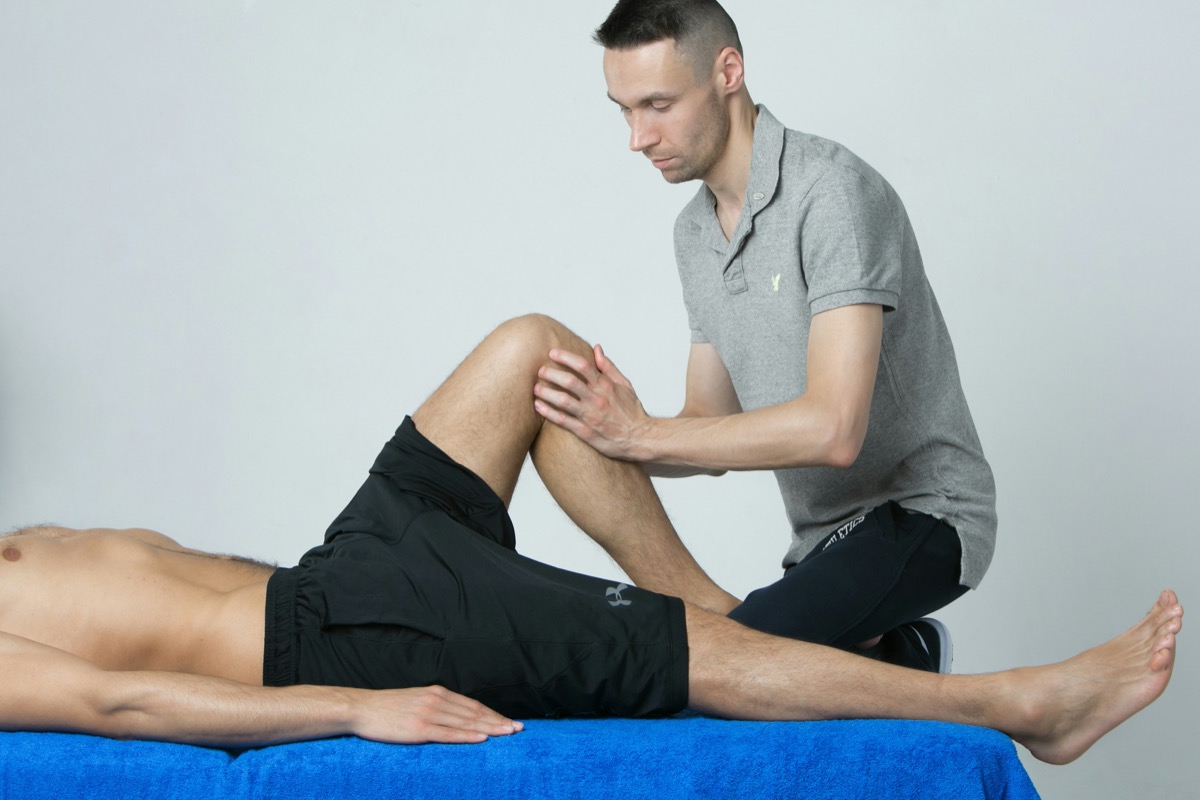
Both hands are doing something.
One supports, one controls the movement — and the exit is already decided.
The role
The Stretch Practitioner Role, in One Sentence.
A stretch practitioner uses practitioner-guided positioning, support, movement and communication to deliver a controlled assisted-stretching session within a professional scope of practice.
The work is hands-on, interactive and driven by what the client reports. A practitioner is not running a routine at somebody; they are carrying part of a person’s body through a movement while that person tells them what is happening, and adjusting continuously on what they hear. That exchange is the job.
Practitioner-guided
The practitioner controls the position, the leverage and the pace while the client stays relatively relaxed. That is what separates this from coaching somebody through a stretch they perform themselves.
Supported
A limb or a body region is carried and stabilised rather than pushed. The support is what makes the movement safe to control, and it is present before the movement starts.
Controlled
Direction, speed, range and exit are all decided by the practitioner and all reversible at any moment. A movement that cannot be reversed under control was never controlled.
Communicated
The client is told what is happening and asked what they feel, continuously. The practitioner cannot feel the stretch, so the client’s report is the only real instrument in the room.
Within scope
Everything above happens inside a defined professional role. What sits outside it — diagnosis, treatment, rehabilitation — stays outside it no matter how the session goes.
Notice what that sentence does not say. A stretch practitioner does not fix mobility, does not correct dysfunction and does not resolve pain. They deliver a service well, inside a role with edges, and the professional skill is as much in the edges as in the technique.
The canonical explanation of the service itself — what a session is, what it should feel like, and how it differs from massage and physical therapy — is on what assisted stretching is.
If the question is the role itself rather than the work — what a stretch practitioner is — defines the professional role, the credential title and what certification does and does not mean.
People also search for “stretch therapist” when they mean this kind of work. ASA calls the service assisted stretching and its credentialed professionals stretch practitioners; what the other phrase does and does not mean is covered in what stretch therapy is.
Before anything is touched
What Happens Before the First Stretch?
The hands-on part of a session is not where it starts. Before a practitioner touches anybody, a set of responsibilities has already been discharged — and a practitioner who skips them has not saved time, they have started a hands-on service without the information and the permission it runs on.
Greet and orient the client
Meeting the client, settling them, and making the first minute of an unfamiliar service feel ordinary. Most people arriving for an assisted stretch have never had one.
Explain what assisted stretching is
In plain language, before it happens: what the practitioner will be doing, what the client will be doing, and how the two interact. A client who does not know what to expect cannot participate properly in something they are supposed to be reporting on.
Clarify the session format
How long it runs, what the general shape of it is, what they will be lying or sitting on, and what happens between positions.
Gather relevant information for service appropriateness
Enough to know whether the service is appropriate today and how it should be adjusted. That is a service question — not a health assessment, and not an attempt to work out what is going on with anybody.
Ask about current comfort and client-reported concerns
What the client is aware of right now, in their own words. The practitioner records what they are told and acts on it; they do not interpret it.
Understand what the client does not want addressed
Areas to leave alone, positions they would rather not be in, contact they would prefer not to have. A client should never have to raise this mid-session because nobody asked.
Explain positioning
What position they will be placed in, and why, before they are placed in it. Nobody consents meaningfully to something they cannot picture.
Obtain permission before hands-on contact
Explicitly, and before the first contact rather than during it. The client is given the moment in which to say no.
Make stopping easy, out loud
Saying plainly that the client can ask to stop, ask for less, or decline any position at any point — and that they do not need a reason. Stopping that has to be argued for has effectively been removed.
Prepare the table and the environment
Equipment set, surfaces clean, the space arranged so the practitioner can work with good body mechanics and the client can be supported properly.
Establish how you will communicate
Agreeing what the client should tell the practitioner and when — where they feel it, when it changes, when it is too much — so feedback during the session is expected rather than volunteered.
All of that is service screening, and none of it is medical assessment. A practitioner asks what they need in order to decide how — and whether — to deliver a session today. They do not diagnose anything, do not decide what is causing anything a client mentions, and do not offer an opinion about it. Where that line sits, and what to do at it, is the subject of the scope-of-practice guide.
Where that boundary sits, and what a practitioner does when a client walks up to it, is the subject of the stretch practitioner scope-of-practice guide.
Where the control comes from
Positioning the Client.
Practitioner-guided stretching depends far more on positioning than people expect. Most of what makes a stretch controlled — or uncontrolled — has already been decided by where the client is, where the practitioner is, and what is supporting what, before any movement begins.
- Placing the client in an appropriate starting position for the technique.
- Supporting the limb or body region that is about to be moved.
- Maintaining stability, so the client is not holding themselves in place.
- Checking that the client is genuinely comfortable in the position, not merely in it.
- Adjusting the table, the props or the client’s own position where that is what is needed.
- Creating appropriate leverage, so the movement comes from position rather than from force.
- Keeping the practitioner’s own body mechanics efficient, because the practitioner is the other half of the mechanics.
This page does not teach individual stretches, and deliberately names none. It describes what the practitioner is responsible for while a technique is happening. The techniques themselves are taught, practised and evaluated in person — which is the part of the pathway that cannot be delivered by reading anything, including this.
How ASA teaches it
Support before movement.
Before moving further into any assisted stretch, a practitioner should be able to answer six questions without pausing to think about them. If any answer is missing, the answer to “should I go further” is already no.
- What is supported?
- What is moving?
- What should stay stable?
- Where are my hands?
- How am I controlling this movement?
- How do I return to neutral from here?
A practitioner should know the exit before the entry.
That last question is the one beginners leave until they need it. A position a practitioner cannot come out of under control is a position they should not have entered, and knowing the exit first is what makes the entry a technique rather than a hope.
During the stretch
Guiding the Movement.
What the practitioner does during the movement itself is mostly restraint. The skill is in how little of it is left to chance: direction, speed, range and exit are all decisions, and all of them stay reversible.
- Move gradually, at a speed the client can respond to.
- Control direction rather than following where the body drifts.
- Manage the range deliberately, and stop short of where it stops being controlled.
- Never force depth — a stretch that has to be forced is finished.
- Use leverage and position instead of arm strength.
- Maintain stability in everything that is not meant to be moving.
- Respond to feedback while it is being given, not after the set.
- Keep every movement deliberate, including the small adjustments.
- Return to neutral under the same control the entry was made with.

Control before depth.
A practitioner working from strength rather than from leverage will get a client into positions they cannot get them out of smoothly, and will tire in a way that makes the last session of the day worse than the first. Both problems are solved in the same place: position, support and mechanics.
Not customer service
Communication is part of the technique.
Communication in an assisted stretch is not customer service. It is the instrument the practitioner uses to know what is happening inside a body they cannot feel from the outside. Without it, a practitioner is working from assumption — and assumption is how range gets taken that nobody agreed to.
- “Tell me when you first feel the stretch.”
- Establishes the beginning of the range from the client’s report rather than from the practitioner’s guess, before anything is committed to.
- “Where do you feel that?”
- Locates the sensation. A stretch felt somewhere other than where it was intended is information that changes what happens next.
- “Is that an appropriate intensity?”
- Asks the only question that matters about depth, and asks it in a form the client can answer honestly instead of a scale they feel graded on.
- “I’m reducing the range.”
- Narrates the adjustment as it happens, so a change the client can feel is never a change they have to interpret.
- “I’m bringing you back to neutral.”
- Announces the exit. The client knows the position is ending and can stay relaxed through the part of the movement where control matters most.
- “Would you like less range?”
- Offers the reduction instead of waiting to be asked for it. A client who has to request less has to overcome the feeling that they are interrupting, and some of them will not.
None of those sentences asks the client to endure anything, none interprets what the client reports, and none offers an explanation for a sensation. They gather information and they narrate action, which is the entire job. A practitioner who is talking and a practitioner who is working are the same practitioner.
Not chasing range
Managing Intensity.
A practitioner is not chasing maximum range, and a session is not a test of how far anybody can be moved. Intensity is managed to a level the client reports as appropriate, and held there under control.
- Work to a stretch sensation the client reports as appropriate for them, today.
- Take the client’s feedback as the measure — there is no external scale being applied.
- Never force a position, and never work through resistance to reach a target.
- Reduce range whenever feedback, comfort or control says so.
- Avoid “deeper is better” thinking, which is a competitive instinct rather than a professional one.
- Keep control of the position for the whole time it is held, not only on the way in.
ASA publishes no numeric intensity scale, and this page invents none. Nor does it tell anyone that a stretch should hurt: pain is not the target, it is not a measure of effectiveness, and a client reporting it is a reason to change what is happening rather than to continue.
The response is always the same
Knowing When to Modify or Stop.
A stretch practitioner should know when to modify, stop or refer.
Reduce range, reposition, return the client to neutral, or end the stretch or the session, when a client reports or shows any of the following. The response is the same whether or not anybody knows why it is happening — and working out why is not part of this role.
- Sharp pain.
- Shooting or electrical sensations.
- Numbness.
- Tingling.
- Pain in a joint.
- Dizziness or light-headedness.
- A feeling of instability or of not being supported.
- Unusual distress, or a change in how they are breathing or speaking.
- Anything that feels unsafe to the client.
- Anything that feels unsafe to the practitioner.
A practitioner does not explain what any of those sensations means, and should not offer a client an explanation for one. That is not caution for its own sake: it is the difference between a non-medical service and a medical opinion delivered by somebody not qualified to give it. A client who wants to know what a sensation means should ask a qualified healthcare professional.
Stopping is a professional skill.
Stopping well is technique, and it is taught as technique. It means coming out under support rather than releasing, saying what is happening while it happens, settling the client, and handling the moment without turning it into an event that frightens them. It is one of the clearest markers of an experienced practitioner, and one of the first things a new one should get good at.
The full treatment of when to modify, stop or refer — and why the response is the same whether or not anybody knows the cause — is in the scope-of-practice guide.
The edge of the role
Knowing When to Refer.
A stretch practitioner does not use the ASA credential to determine what is medically wrong with anybody. What they do instead is recognise when a person in front of them needs something this role does not provide, and say so plainly.
- The client’s concern is outside what this professional role covers.
- The client is asking for a medical evaluation, an opinion or a determination.
- Symptoms have come up that concern the client or the practitioner.
- The practitioner is not confident the service is appropriate for this person today.
- What the client needs is something this role does not provide — diagnosis, treatment or rehabilitation.
- A policy that applies — an employer’s, a facility’s or an insurer’s — requires referral or clearance first.
Referral is not failure. It is knowing the edge of your role.
Referring does not mean deciding what is wrong or naming the professional a client should see for a particular condition. It means saying, without alarm, that this is outside what a stretch practitioner does and that a qualified healthcare professional is the right person to ask. Postponing a session is a legitimate outcome, and a practitioner who is uncertain has already been given the answer by the uncertainty.
The half beginners skip
Returning the Client to Neutral.
Every position has an exit, and the exit is part of the technique rather than the end of it. A practitioner controls the return as deliberately as the entry — which is the half of the movement beginners stop paying attention to.
- Reduce range gradually rather than coming out in one movement.
- Keep supporting the limb or region all the way back.
- Never drop, release or let go of a supported body part.
- Reposition the client rather than leaving them to rearrange themselves.
- Confirm they are comfortable before anything else starts.
- Set up whatever comes next from a settled position, not from the end of the last one.
The technique is not finished until the client is safely returned to neutral.
A hands-on job
Professional touch has a purpose.
Assisted stretching is delivered hands-on, which puts professional conduct at the centre of the work rather than at the edge of it. Anybody considering this role should be comfortable with that being a permanent, deliberate part of the job. The expectations below are ASA’s professional standard; they are not a summary of any jurisdiction’s rules about contact, which exist, differ between places, and are not ASA’s to state.
- Contact has a clear purpose connected to the technique being performed.
- Positioning is explained before it is used.
- Conduct stays professional, and the relationship stays a working one.
- Unnecessary contact is avoided rather than justified.
- Client preferences are respected without requiring an explanation.
- Draping and clothing expectations appropriate to the setting are maintained.
- Facility policy is followed, including where it is stricter than a practitioner’s own habit.
- The session stops if the client is uncomfortable — with the position, the contact or anything else.
A practitioner unsure whether a particular contact is appropriate already has the answer: explain it first, offer an alternative, or leave it out. Nothing in a stretching session is worth a client’s discomfort about being touched, and a client’s discomfort is never a problem to be talked them out of.
A continuous responsibility
Consent is ongoing, not a one-time form.
A signature at the front desk records that somebody agreed to receive a service. It does not record that they agree to this position, at this depth, right now — and that is the consent a hands-on session actually runs on. Managing it is a practitioner responsibility that lasts the whole session.
Informed participation
The client should understand what the service is and what a session involves before it starts, in ordinary language rather than in professional shorthand.
Permission before contact
Contact is explained before it happens, not narrated afterwards. A practitioner says what they are about to do and where, and gives the client the moment in which to say no.
The client may stop anything, at any point
Stopping is always available, always immediate, and never something a client has to argue for. A practitioner who makes stopping mildly awkward has effectively removed it.
The client may decline a stretch outright
Declining one position is not declining the session, and it is not a problem to be solved. The practitioner works with what is left rather than negotiating.
The client may ask for less
Reducing intensity or range on request is an ordinary adjustment, made without comment and without implying that less is a lesser session.
Positioning is explained before it is used
A client who is about to be moved into an unfamiliar position should hear what it is first. Nobody consents meaningfully to something they cannot picture.
Consent can change mid-session
What was fine ten minutes ago may not be fine now, and the practitioner keeps checking rather than assuming the earlier answer still holds.
None of that is a description of any jurisdiction’s legal requirements about consent or documentation, and it is not legal advice. It is the professional standard ASA teaches. What paperwork is required, and what it must contain, is set by the law where a practitioner works and by their employer.
Consent, boundaries and the professional standard around them are covered in full in the stretch practitioner scope-of-practice guide.
The last five minutes
What Does a Practitioner Do After the Session?
The session does not end when the last technique does. What follows is short, and it is mostly professional housekeeping — the part of the job that decides whether the service reads as professional or merely as pleasant.
- Help the client back to a normal position and off the table safely.
- Ask how they are feeling, and listen to the answer.
- Answer service questions — what the session covered, what a next appointment involves.
- Explain appropriate next steps that sit inside the role, and nothing that sits outside it.
- Complete whatever documentation the business or facility requires.
- Schedule or follow up where that is part of the role.
- Note client preferences and reported concerns according to policy, so the next session starts from what is already known.
- Escalate incidents through the organization’s procedures where required.
What a practitioner does not do afterwards is prescribe aftercare. No home programme, no remedy, no instruction about what to do with a body part, and no explanation of why anything felt the way it did. A client with a question of that kind should ask a qualified healthcare professional, and saying so is a complete and professional answer.
The whole thing, in order
A Typical Practitioner Session Flow.
Put together, a session has a shape. It is not a script and it is not a technique sequence — what the practitioner does in step eleven depends entirely on the client in front of them — but the arc is consistent, and it is the clearest picture of the role there is.
- 1
Welcome and explain
- Greet the client and explain what the session involves in ordinary language.
- 2
Screen for service appropriateness
- Gather what is needed to decide whether and how the service runs today.
- 3
Confirm consent
- Permission for contact, explicitly, with stopping made easy out loud.
- 4
Position the client
- Place them appropriately for what is about to happen, and explain it first.
- 5
Support the body
- Establish support and stability before anything moves.
- 6
Guide the stretch
- Move gradually and deliberately, controlling direction and range.
- 7
Communicate
- Ask what they feel, narrate what is happening, and keep the exchange running.
- 8
Adjust range and intensity
- Work to what the client reports as appropriate, and change it when they do.
- 9
Modify or stop if needed
- Reduce, reposition, return to neutral or end it — on feedback, not on a schedule.
- 10
Return to neutral
- Come out under control and under support, and confirm the client is comfortable.
- 11
Continue through the session
- Repeat the cycle through whatever sequence is appropriate for this client.
- 12
Close, document, follow up
- Settle the client, complete required documentation, and handle next steps.
Steps four through ten repeat for every position in a session, which is why they are the part ASA teaches in person and evaluates in person. A practitioner is not learning twelve steps; they are learning one loop well enough to run it under pressure with a stranger’s body.
The same session described for the person receiving it — what to expect during an assisted stretching session — covers what a client should expect from arrival to the end of the appointment, including how consent works during a session and what happens when somebody asks to stop.
All of it learnable
What Skills Does a Good Stretch Practitioner Need?
The skills this role asks for are learnable, and they are not all physical. Roughly half of what makes a practitioner good at the work has nothing to do with their hands.
Communication
- Asking clearly, listening properly and narrating what is happening.
Client awareness
- Noticing how someone is responding before they say anything about it.
Professional touch
- Contact that is purposeful, explained and comfortable to receive.
Positioning
- Setting a client up so the technique is controlled before it starts.
Body mechanics
- Working from a base that is stable and sustainable across a full day.
Leverage
- Producing movement from position rather than from effort.
Stability
- Keeping everything that should not move exactly where it is.
Controlled movement
- Direction, speed and range as deliberate decisions.
Patience
- Letting a position develop instead of arriving at it.
Attention to feedback
- Hearing what a client reports and acting on it immediately.
Professional boundaries
- Knowing where the role ends and staying inside it under pressure.
Decision-making
- Choosing what happens next while both hands are occupied.
Consent awareness
- Treating permission as continuous rather than as a signature.
Ability to modify
- Changing the plan for the person actually on the table.
Knowing when to stop
- Ending a technique or a session cleanly, without drama.
Knowing when to refer
- Recognising what belongs with somebody else.
Consistency
- Delivering the same standard on a quiet Tuesday as on a busy Saturday.
Professionalism
- Conduct, presentation, timekeeping and documentation, every time.
Every one of those is developed rather than possessed. ASA makes no claim about what kind of person suits this work — there is no personality type this role requires, and a page that told you there was would be describing its own students rather than the job.
Two halves of one job
Physical Skill vs Professional Skill.
Physical and technique skills
- Positioning
- Leverage
- Support
- Movement control
- Body mechanics
- Range management
Professional skills
- Communication
- Consent
- Scope awareness
- Boundaries
- Client experience
- Documentation
- Referral judgement
- Professionalism
A great technique without professional judgement is not enough.
The two columns fail differently. A practitioner weak on the left produces sessions that are uncomfortable or ineffective; a practitioner weak on the right produces sessions that are a problem. Which is why ASA assesses both, and why the credential is not issued on technique alone.
The boundary
What Does a Stretch Practitioner Not Do?
The ASA credential does not by itself authorize anybody to:
- Diagnose injuries.
- Diagnose medical conditions.
- Diagnose dysfunction.
- Prescribe treatment.
- Prescribe rehabilitation.
- Represent assisted stretching as physical therapy.
- Claim to cure pain.
- Claim to heal injuries.
- Provide healthcare services reserved to licensed professions.
- Operate outside applicable law.
- Operate outside the terms of their insurance.
- Operate outside employer or facility policy.
The ASA credential does not authorize diagnosis, medical treatment or rehabilitation.
A practitioner who independently holds another licence or credential still has whatever scope that profession gives them — a licensed professional does not lose anything by adding ASA certification. What ASA certification does not do is widen it. The two scopes sit side by side, and the other profession’s rules keep governing the other profession’s work.
What the role does include, what sits outside it and what actually decides the difference is the subject of the stretch practitioner scope-of-practice guide.
Related, not interchangeable
Stretch Practitioner vs Personal Trainer.
Stretch practitioner
- Delivers practitioner-guided stretching.
- Positions and supports the client.
- Works hands-on throughout.
- Manages range and intensity from client feedback.
- Communicates continuously, as part of the technique.
Personal trainer
- Instructs and coaches exercise.
- Designs fitness programming within their scope.
- Works largely through strength and conditioning.
- The client performs the movement.
- Communicates as coaching and instruction.
One person can hold both roles, and a great many do — trainers are the single most common background among people studying assisted stretching. Holding one credential does not define the other, and neither one automatically permits the work of the other.
What adding assisted stretching involves for a trainer specifically — what transfers, what is genuinely new, and what decides whether they may offer it — is covered in assisted stretching for personal trainers.
The version written for the people you would be working with: assisted stretching vs personal training — what happens in each kind of session, who is doing the movement, where hands-on contact fits, and why one professional can hold both roles without the two becoming one credential.
Two hands-on services
Stretch Practitioner vs Massage Therapist.
Assisted stretching
- Guided positioning and controlled movement into stretches.
- The practitioner moves and supports the client.
- Managed by range, leverage and client-reported sensation.
- Delivered as a non-medical service.
Massage therapy
- Professional hands-on soft-tissue work.
- A licensed profession in many places, with exact scope varying by jurisdiction.
- Governed by that profession’s own rules, titles and requirements.
- Related to assisted stretching, and not the same service.
A practitioner may hold both, and licensed massage professionals are a common ASA background. What ASA certification does not do is expand, replace or substitute for massage licensure — a licensed therapist’s scope is set by their licence and their board, exactly as it was before they added anything.
What the subject means for a licensed massage professional specifically is covered in assisted stretching for massage therapists.
Not two versions of one job
Stretch Practitioner vs Physical Therapist.
These are not two versions of the same job and this page claims no equivalence between them. Physical therapy is a licensed healthcare profession. An ASA stretch practitioner delivers a non-medical, practitioner-guided stretching service under ASA’s credential, and that credential is not a healthcare licence.
ASA stretch practitioner
- A non-medical role delivering practitioner-guided stretching.
- Certified by ASA on education, assessment and demonstrated competency.
- Works within professional boundaries and refers outward.
- Not a healthcare provider, and not a licensed healthcare profession.
Physical therapy
- A licensed healthcare profession.
- Entry, title and practice governed by law and by a licensing authority.
- Includes clinical evaluation and treatment of conditions.
- Delivered by professionals who hold that licence and no one else.
An ASA Certified Stretch Practitioner does not use the credential to:
- Diagnose.
- Treat medical conditions.
- Prescribe rehabilitation.
- Provide physical therapy.
The full professional-boundary treatment, including what a practitioner does when a client asks for something that belongs to a licensed healthcare profession, is in the stretch practitioner scope-of-practice guide.
The version written for the people you would be working with: assisted stretching vs physical therapy — why the ASA credential does not authorize diagnosis, medical treatment or rehabilitation, what to do when a client is already under a provider’s care, and when to refer.
The same comparison against chiropractic care, which this work gets confused with constantly: assisted stretching vs chiropractic care — why the ASA credential does not authorize chiropractic adjustment, why an assisted stretch is not one, and what to say when a client asks for something that belongs to another profession.
Settings, not vacancies
Where Do Stretch Practitioners Work?
Assisted stretching is delivered in a range of environments, and the setting changes the job around it — the policies, the documentation, the pace and the way the service is presented.
Assisted-stretching studios
Businesses built around the service itself, where it is the whole offering rather than an addition.
Gyms and fitness facilities
Clubs offering it as its own appointment type alongside training and other services.
Wellness studios
Multi-service wellness environments where it sits beside other one-to-one offerings.
Massage and wellness businesses
Businesses whose staff often already hold hands-on credentials of their own.
Sports and performance facilities
Environments working with athletic populations, where the service is one part of a wider setup.
Multidisciplinary wellness environments
Settings where several professions work in one building, each within its own scope.
Independent practice, where permitted
Working for oneself — which depends on far more than skill, and is covered in the next section.
That is a description of where the work happens, and it is not a claim about permission or about employment. It does not say the role is permitted in every jurisdiction or in every one of those settings, because that is decided by applicable law, licensing requirements, insurance and each business’s own policy rather than by any certification. And it is not a statement that positions are available: ASA does not place practitioners, does not guarantee employment and makes no claim about the job market anywhere.
How a fitness facility would actually run the service — staffing, standards, consent, insurance and what a program needs beyond a service menu — is covered in assisted stretching for gyms and fitness facilities.
A business question
Can Stretch Practitioners Work for Themselves?
Potentially — and it depends on considerably more than skill. Whether any individual can work for themselves is decided by applicable law, licensing requirements, insurance, business requirements where they operate and their own professional scope. ASA makes no determination for anyone and guarantees no clients, no bookings and no business outcome.
Service definition
What is actually being offered, described accurately and without implying anything clinical.
Pricing
A decision for the business, made against its own costs and market. ASA publishes no guidance on it.
Scheduling
How appointments are booked, confirmed, moved and cancelled.
Client forms
What is collected before a first session, and how it is stored and protected.
Insurance
Coverage that actually covers the service being provided — which is a question for an insurer, not for a certifier.
Facility or space
Somewhere appropriate to deliver a hands-on service, on terms that permit it.
Marketing
Describing the service honestly, with no health, treatment or outcome claim attached to it.
Professional boundaries
Harder to hold alone than in an organization, and more important, because nobody else is setting them.
Local business requirements
Registration, permits, tax and any other requirement that applies where the business operates.
Every item on that list is a business question rather than a stretching question, and none of them is settled by a certification. Anyone considering it should confirm what applies to them with the appropriate authority, their insurer and their own professional adviser.
Program in Development ASA is separately developing the STRRRETCH Partner Studio Pathway for practitioners interested in their own assisted-stretching environment. Structure, availability, requirements and terms are still being developed, and certification and business participation are separate.
No single version of it
What Does a Practitioner’s Day Look Like?
There is no single practitioner workday, and anyone describing one is describing a particular job rather than the role. A day may include some of the following, in a mix that depends entirely on the setting and on how the person is engaged.
- Preparing the room, the table and the equipment before the first appointment.
- Reviewing the schedule and what is already known about the clients on it.
- Greeting clients and explaining sessions, repeatedly, to people who have never had one.
- Delivering assisted-stretch sessions, which is the core of the day.
- Documenting sessions according to business or facility policy.
- Cleaning and resetting equipment between clients.
- Communicating with clients about scheduling and service questions.
- Following up where that is part of the role.
- Coordinating with management, reception or the wider team.
- Maintaining professional education and continuing to develop technique.
- Handling scheduling, admin or business tasks, depending on the role and setting.
How many sessions a day includes, how long they run and how they are spaced varies by employer, by business and by individual, and this page states no figure for any of them. It is physical work: a practitioner is on their feet, supporting other people’s body weight, repeatedly. Body mechanics are not an aesthetic preference in this role — they are what makes the last session of the day as good as the first.
Your call, not ours
Who May Enjoy This Kind of Work?
Nobody can tell you from a web page whether a career suits you, and this page is not going to try. What it can do is describe what the work asks of somebody day to day, so you can recognise how much of it appeals.
- One-to-one work with the same person for a whole appointment.
- Hands-on professional work, as a permanent part of the job.
- Movement and wellness as a field to work in.
- Learning technique properly, and being evaluated on it.
- Structured, repeatable routines done to a standard.
- Communication as a working tool rather than as small talk.
- Attention to detail in things most people would not notice.
- Guiding somebody through a service they have not had before.
- Developing a professional skill over years rather than weeks.
ASA makes no claim that this is the right career for anybody, that it is easy, or that it is a perfect fit for any particular kind of person. It is skilled hands-on work with real professional responsibilities attached to it, and whether that appeals is genuinely yours to decide.
A head start, not a shortcut
Who May Already Have Relevant Experience?
Several backgrounds arrive with a genuine head start, mostly in the parts of the work that are not the hands-on ones: working one-to-one, explaining an unfamiliar service, holding a professional boundary, and knowing what a body is and is not built to do.
- Personal trainers
- Massage therapists
- Coaches
- Fitness professionals
- Wellness professionals
- Sports and performance professionals
- Career changers with relevant education
Prior professional experience may support learning, but it does not replace assisted-stretching-specific competency.
The parts that are genuinely new to almost everyone are the hands-on ones — supporting and positioning another person, calibrating leverage, and reading feedback through contact rather than through observation. That is true of an experienced trainer and of a licensed massage professional alike, and it is the part a certification has to actually develop and verify.
Two of those backgrounds have guides of their own: assisted stretching for personal trainers and assisted stretching for massage therapists. Both answer the same question this section raises for one profession specifically — what transfers, what is new, and what actually decides whether they may offer it.
Another background this question comes up for constantly is yoga teaching: assisted stretching vs yoga — who is guiding the movement, what a yoga background may and may not transfer, and why a similar-looking position does not make two things the same.
Two different questions
Do You Need Certification to Be a Stretch Practitioner?
Whether certification is legally required depends on the jurisdiction, the role and the workplace, and this page states no universal answer because there is not one. What can be said plainly is what certification is for: ASA certification documents completed ASA education, assessed knowledge and demonstrated practical competency in assisted stretching.
Certification documents education and competency; it does not determine legal scope of practice.
What certification documents
That a practitioner completed a defined education pathway, passed its assessments and demonstrated hands-on competency in front of an evaluator. That is a real, checkable claim about a person’s preparation.
What certification does not do
It does not grant legal permission, create a licence, override a licensing requirement or settle what any individual may offer where they work. Those are decided elsewhere, and they applied before the certificate and apply after it.
What an employer may require
A facility, employer or insurer may independently require certification — often will — and may require more than the law does. That is their decision to make about their own business, and it is a separate question from what the law requires.
Certification and legal permission are not the same thing.
What certification does not decide
Certification does not determine a practitioner’s legal scope of practice. Laws, professional licensing requirements, title restrictions, insurance conditions and facility policies vary by state, by country and by employer, and they apply to a certified practitioner exactly as they applied before. Anyone entering this field is responsible for confirming what they are permitted to do where they intend to work, and for consulting the appropriate licensing authority or their own professional adviser where that is unclear.
The full treatment of that distinction is in the stretch practitioner scope-of-practice guide.
The pathway
How ASA Certification Prepares a Practitioner.
ASA’s pathway is built around the gap this page has been describing: the difference between knowing what a practitioner does and being able to do it with a stranger on a table. It runs in six stages, and the credential is the last of them rather than the first.
- 1
Fast Track preparation
- Six short online modules, completed before class, that get a student ready for the hands-on day rather than teaching the technique.
- 2
Knowledge assessments
- An online assessment before class, requiring 80% with every safety question answered correctly.
- 3
One-day ASA hands-on certification training
- One full day in person, with real bodies, learning ASA's signature 25-minute and 50-minute routines. Positioning, support, leverage, control and the exits — the part of this role that cannot be learned by reading about it.
- 4
Practical competency
- Demonstrated hands-on, in front of an evaluator. This is where technique, communication and judgement are assessed together rather than separately.
- 5
The ASA Safety Commitment
- A signed professional commitment to the safety and boundary standards the education teaches. It is a condition of the credential rather than a formality attached to it.
- 6
The ASA Certified Stretch Practitioner credential
- Issued on review once every requirement above is satisfied — never automatically on a passing score.
- Fast Track gets you ready for class.
- Hands-on training develops the skill.
- Practical competency earns the credential.
Competency before credential.
How each stage actually works, what a quality programme contains and how to compare providers is covered in the assisted stretching certification guide.
Decided this is the work you want? How to become a stretch practitioner walks through the whole path — the education, the hands-on training, the practical competency and the requirements no certification settles for you.
Two different things
Online Education vs Practitioner Certification.
Online education and practitioner certification are two different things, and the difference matters more on this page than anywhere else on the site — because one of them prepares a practitioner and one of them does not. ASA is not currently offering an online-only program to the public.
Online-only education
- Online education.
- Ends in a Certificate of Completion.
- No hands-on component and no practical evaluation.
- Not the practitioner credential.
ASA Certified Stretch Practitioner
- ASA's one-day certification.
- Includes in-person hands-on training.
- Includes assessed practical competency.
- The credential, issued once every requirement is satisfied.
A Certificate of Completion records that somebody finished a course. The credential records that somebody demonstrated they can do the work. Anyone comparing the two — or comparing ASA against another provider — should read the cost guide, which sets out what ASA's tuition covers and what actually drives the difference.
What ASA's certification costs, and what actually drives the difference between programs, is on the certification cost guide.
Fifteen questions
The Practitioner Readiness Checklist.
Before working independently with clients, a practitioner should be able to answer all fifteen of these. They are not a test and nobody marks them — they are the shape of what competence in this role actually consists of.
Can I explain assisted stretching accurately, to someone who has never had it?
Do I understand my professional role, including where it ends?
Can I position and support a client confidently?
Can I control the movement, in both directions?
Can I use leverage rather than relying on arm strength?
Can I communicate throughout the stretch, while I am working?
Can I adjust range based on what a client tells me?
Can I recognise when to modify or stop?
Can I return a client safely to neutral, every time?
Do I understand consent, and treat it as ongoing?
Do I understand professional boundaries, including under pressure?
Do I know when something is outside my role?
Do I know when referral may be appropriate?
Is this service permitted under the professional and workplace rules that apply to me?
Does my insurance cover what I am actually providing?
- Know the skill.
- Know the role.
- Know the boundaries.
The last two are the ones people skip, and they are the two a certification cannot answer for anybody. Confirming them is the practitioner’s own responsibility, and the people who can answer them are the licensing authority where you work, your insurer and your employer.
Questions
The Stretch Practitioner Role: FAQ.
What does a stretch practitioner do?
An assisted stretch practitioner guides clients through practitioner-assisted stretching using positioning, support, controlled movement, communication and range management. The role includes preparing the client, supporting the body through each technique, monitoring feedback, adjusting intensity, maintaining professional boundaries and returning the client safely to neutral. It is a non-medical service: practitioners do not use the ASA credential to diagnose injuries, provide medical treatment or prescribe rehabilitation.
What is an assisted stretch practitioner?
An assisted stretch practitioner is a trained professional who delivers practitioner-guided stretching as its own service. They position and support the client, control the movement, and manage range and intensity from the client’s own feedback while the client stays relatively relaxed. ASA’s credential for the role is the ASA Certified Stretch Practitioner.
What does a stretch therapist do?
“Stretch therapist” is a term people commonly search for, and it usually refers to the same kind of session an assisted stretch practitioner delivers. ASA does not use it as a credential title: its professional credential is the ASA Certified Stretch Practitioner, and the service is assisted stretching. The term has no single universal legal definition, and the word “therapy” in it does not by itself indicate healthcare. ASA publishes a separate terminology guide covering what the phrase does and does not mean.
What does a stretch practitioner do during a session?
They position the client, establish support and stability, guide the stretch gradually and under control, communicate continuously, adjust range and intensity from what the client reports, modify or stop when feedback calls for it, and return the client to neutral under support before moving on. That loop repeats for each position in the session.
What happens before an assisted stretching session?
The practitioner greets and orients the client, explains what assisted stretching is and how the session runs, gathers the information needed to decide whether and how the service should be delivered today, asks about current comfort and any areas the client does not want addressed, explains positioning, obtains permission before hands-on contact, makes clear that the client can ask to stop or for less at any point, and prepares the table and the space. That is service screening, not a medical assessment.
Does a stretch practitioner touch the client?
Yes. Assisted stretching is a hands-on service: the practitioner supports and positions the client’s body in order to control the movement. Contact should have a clear purpose connected to the technique, should be explained before it happens, and should stop the moment a client is uncomfortable. Anyone considering this work should be comfortable with professional hands-on contact being a permanent part of the job.
Does a stretch practitioner move the client’s body?
Yes — that is the defining feature of the service. The practitioner carries and guides a limb or body region through a controlled range while the client stays relatively relaxed, rather than coaching the client to perform the movement themselves. Direction, speed, range and exit are all controlled by the practitioner and all reversible at any moment.
How does a stretch practitioner know how far to stretch someone?
From the client. The practitioner cannot feel the stretch, so the client’s report is the measure: where they first feel it, where they feel it, whether the intensity is appropriate, and whether they want less. There is no external scale being applied and no target range being pursued — ASA publishes no numeric intensity scale, and a practitioner chasing depth has stopped managing the session.
Should assisted stretching hurt?
No. Pain is not the goal, and it is not a measure of whether a session is working. A client who reports sharp pain, shooting or electrical sensations, numbness, tingling, joint pain, dizziness, instability or unusual distress is telling the practitioner to reduce range, reposition, return to neutral or stop — not to push through. What a sensation means is a question for a qualified healthcare professional, not for a stretch practitioner.
What should a stretch practitioner do if a client feels sharp pain?
Reduce the range, reposition, return the client to neutral under support, or end the stretch or the session — immediately, and without needing to know why it is happening. The practitioner does not work through it, does not investigate the cause and does not explain the sensation to the client. If it concerns either of them, referral to a qualified healthcare professional is the appropriate next step.
Can a stretch practitioner diagnose injuries?
No. Diagnosing injuries, conditions or dysfunction is outside the role, and the ASA credential does not authorize it. A practitioner can adjust a session around what a client reports without ever forming or sharing a conclusion about what is causing it. Anyone wanting to know what is wrong should ask a qualified healthcare professional.
Can a stretch practitioner treat pain?
No. Treating pain is not what this role does and the ASA credential does not authorize it. Assisted stretching is a non-medical service, ASA makes no claim that it relieves, resolves or manages pain, and a practitioner who offered it as treatment for pain would be working outside the role they were certified in.
Can a stretch practitioner rehabilitate injuries?
No. Rehabilitation is a healthcare activity, it sits outside the role, and the ASA credential does not authorize it. A practitioner who independently holds a healthcare licence works under that profession’s scope for that profession’s work — ASA certification neither adds to it nor takes anything from it.
Is a stretch practitioner a physical therapist?
No, and the two should not be presented as versions of each other. Physical therapy is a licensed healthcare profession with entry, title and practice governed by law and by a licensing authority. An ASA stretch practitioner delivers a non-medical, practitioner-guided stretching service under ASA’s credential, which is not a healthcare licence and does not authorize diagnosis, treatment, rehabilitation or the provision of physical therapy.
Is a stretch practitioner a massage therapist?
No. Massage therapy is a distinct profession, licensed in many places, with its own scope, title rules and requirements that vary by jurisdiction. Assisted stretching is guided positioning and controlled movement into stretches. A person may hold both credentials, and ASA certification does not expand, replace or substitute for massage licensure.
Is a stretch practitioner a personal trainer?
No, although many practitioners are also trainers. Personal training is delivered largely through instruction and programming, with the client performing the movement. Assisted stretching is delivered through hands-on positioning, support and practitioner-controlled movement, with the client staying relaxed. They are related services and they are not interchangeable.
Can a personal trainer also be a stretch practitioner?
Personal trainers can study assisted stretching as an additional professional skill, and a large share of ASA students arrive already working as trainers. Whether any individual trainer may offer it is a separate question, decided by applicable law, any licensing rules that already apply to them, employer and facility policy, and insurance — not by any certification.
Can a massage therapist also be a stretch practitioner?
Massage therapists can and do study assisted stretching, and they arrive with real advantages: anatomy knowledge, hands-on experience and established professional boundaries. What certification does not do is widen a licence. A licensed therapist’s scope is set by their licence, their board and the law where they practise, exactly as it was before.
Where do stretch practitioners work?
Assisted stretching is delivered in assisted-stretching studios, gyms and fitness facilities, wellness studios, massage and wellness businesses, sports and performance facilities, multidisciplinary wellness environments, and independent practice where that is permitted. That describes where the work happens; it is not a claim that the role is permitted in every jurisdiction or setting, and not a statement that positions are available anywhere.
Can stretch practitioners work in gyms?
Gyms and fitness facilities do offer assisted stretching, usually as its own appointment type rather than folded into a training session. Whether any particular facility offers it, and who may deliver it there, depends on applicable law, the credentials of the people delivering it, insurance and the facility’s own policies. ASA makes no determination for any facility or practitioner.
Can stretch practitioners work for themselves?
Potentially, and it depends on considerably more than skill: applicable law, licensing requirements, insurance that actually covers the service, local business requirements, somewhere appropriate to deliver it, and the practitioner’s own professional scope. ASA makes no determination for anyone, publishes no pricing guidance and guarantees no clients, bookings or business outcome.
What skills does a stretch practitioner need?
Physical and technique skills — positioning, leverage, support, movement control, body mechanics and range management — and professional skills — communication, consent, scope awareness, boundaries, client experience, documentation, referral judgement and professionalism. Both halves are learned, and a strong technique without professional judgement is not enough.
Is assisted stretching physically demanding for the practitioner?
It is physical work. A practitioner is on their feet, supporting other people’s body weight through controlled movement, repeatedly. That is exactly why body mechanics and leverage are taught as core skills rather than as refinements: a practitioner working from arm strength will tire in a way that makes the last session of the day worse than the first.
Do stretch practitioners need good communication skills?
Yes, and not as a customer-service nicety. Communication is part of the technique: the practitioner cannot feel the stretch, so asking what the client feels, narrating what is happening and offering less range are the instruments used to manage the session. A practitioner who stops communicating is working from assumption.
Is consent required during assisted stretching?
Consent is treated as ongoing rather than as a form signed once. Permission is obtained before contact and before a change of position, the client may decline any technique, ask for less intensity or ask to stop at any point, and consent can change during a session. What paperwork is legally required is set by the law where a practitioner works and by their employer, and ASA gives no legal advice on it.
When should a stretch practitioner stop a stretch?
When the client reports or shows sharp pain, shooting or electrical sensations, numbness, tingling, joint pain, dizziness, instability, unusual distress or anything that feels unsafe — to either of them. The response is the same whether or not anybody knows why it is happening. Stopping well is a professional skill: coming out under support and under control, saying what is happening, and settling the client.
When should a stretch practitioner refer someone?
When what the person needs is something this role does not provide. That includes a client asking for a diagnosis, an opinion or medical treatment, a concern outside what the role covers, symptoms that worry either party, genuine uncertainty about whether to continue, or a policy that requires clearance first. Referral means saying plainly that this is outside what a stretch practitioner does — not deciding what is wrong.
Do stretch practitioners need certification?
There is no single universal answer: whether certification is legally required depends on the jurisdiction, the role and the workplace. Many employers and facilities require it independently of what the law says. What certification does is document completed education, assessed knowledge and demonstrated practical competency — which is a different thing from legal permission.
Is ASA certification a license?
No. ASA is an education and certification organization, not a licensing authority, and the ASA Certified Stretch Practitioner credential is not a licence. Certification does not determine a practitioner’s legal scope of practice. Laws, professional licensing requirements, title restrictions, insurance conditions and facility policies vary by state, by country and by employer, and they apply to a certified practitioner exactly as they applied before. Anyone entering this field is responsible for confirming what they are permitted to do where they intend to work, and for consulting the appropriate licensing authority or their own professional adviser where that is unclear.
What is the ASA Certified Stretch Practitioner credential?
The ASA Certified Stretch Practitioner is ASA’s professional credential for assisted stretching. It is issued after a student completes the six online Fast Track preparation modules and passes the knowledge assessment, attends in-person hands-on certification training, demonstrates practical competency in front of an evaluator and signs the ASA Safety Commitment. It documents education and demonstrated competency; it does not determine legal scope of practice.
How does someone become an ASA Certified Stretch Practitioner?
Through ASA’s pathway: Fast Track preparation (six short online modules), an online knowledge assessment, one-day in-person hands-on certification training, assessed practical competency and the ASA Safety Commitment. The credential is issued on review once every requirement is satisfied, never automatically on a passing score.
Is ASA certification completely online?
No, and deliberately not. ASA's preparation modules are delivered online, but the practitioner credential also requires in-person hands-on training and an assessed practical competency component. Positioning, support, leverage and control are things a person either can or cannot do with another human being, and no online course can verify that.
Does ASA require hands-on training?
Yes. In-person hands-on certification training and demonstrated practical competency are both requirements for the ASA Certified Stretch Practitioner credential. ASA is not currently offering an online-only program to the public.
How long does it take to become a stretch practitioner?
There is no single universal duration. The ASA pathway combines six short online Fast Track preparation modules and a knowledge assessment, a one-day in-person hands-on certification training and an assessed practical competency component. How long that takes end to end depends on when an individual completes the preparation, which training date they choose, and when competency is reviewed.
How much does stretch practitioner certification cost?
It depends on what a programme includes — online-only education against a full pathway with in-person training and practical evaluation. ASA publishes its current tuition, what it covers and what drives certification pricing generally in its certification cost guide, which is where those figures are stated with the context they need.
Can I make a career out of assisted stretching?
People do pursue assisted stretching professionally, in studios, gyms, wellness businesses and independent practice where that is permitted. What ASA will not tell you is that it guarantees anything: ASA does not guarantee employment, clients, income or business results, publishes no earnings figures, and makes no claim about the job market in any location. What ASA provides is education, assessment and a credential.
Does ASA guarantee a job after certification?
No. ASA is an education and certification organization. It does not place practitioners, does not guarantee employment or interviews, and makes no claim about hiring in any market. Employers set their own hiring requirements, and some require certification independently of what the law requires.
Does ASA guarantee clients or income?
No. ASA guarantees no clients, no bookings, no income and no business outcome to anybody, and publishes no earnings, salary or revenue figures. Whether a practitioner or a business succeeds depends on many things a certification does not control.
What is the difference between online education and full certification?
Online-only education ends in a Certificate of Completion. ASA is not currently offering an online-only program to the public. The ASA Certified Stretch Practitioner credential is the full pathway: it adds in-person hands-on training and an assessed practical competency component, and the credential is issued only once every requirement is satisfied. A Certificate of Completion records that somebody finished a course; the credential records that somebody demonstrated they can do the work.
Where can I learn more about stretch practitioner scope of practice?
ASA publishes a full scope-of-practice guide covering what the role includes, what sits outside it, when to modify, stop or refer, and why certification and legal permission are two different things. It is the page every other ASA guide defers to on professional boundaries, and it is free to read.
Where this goes next
Learn the Role. Build the Skill. Earn the Credential.
If the work described on this page fits your professional goals, ASA’s pathway runs from foundational education through in-person hands-on training to assessed practical competency. What ASA provides is education, assessment and a credential. It does not provide employment, clients, income or a guarantee of any business outcome, and it never claims to.
- Learn the role.
- Build the skill.
- Earn the credential.
Explore ASA Certification · See Certification Cost
Review the stretch practitioner scope of practice — the guide every other ASA page defers to on professional boundaries.
More ASA guides: what assisted stretching is, how certification works, what it costs.