
Understanding the difference
Assisted Stretching vs Physical Therapy: What’s the Difference?
Assisted stretching and physical therapy are not the same service. Assisted stretching, as taught by ASA, is non-medical practitioner-guided stretching focused on positioning, support, controlled movement, communication and professional boundaries. Physical therapy is a licensed healthcare profession that may include evaluation, diagnosis within the therapist’s professional authority, treatment and rehabilitation.
An ASA Certified Stretch Practitioner does not use the ASA credential to diagnose injuries, provide medical treatment or prescribe rehabilitation.
If someone is seeking evaluation of an injury, diagnosis, medical treatment or rehabilitation, a licensed healthcare professional may be the appropriate starting point.
ASA defines its own assisted-stretching educational model and the professional standard it holds its own practitioners to. ASA does not define, regulate, accredit or set standards for physical therapy, and nothing on this page decides what any physical therapist may do. Everything said here about physical therapy is stated at the level of generality ASA can support, and anything more specific belongs to the profession and the licensing system that own it.
This guide is written for two readers. One is trying to work out which of these two services they are actually looking for. The other is a professional — a practitioner, a trainer, a facility, or a licensed clinician — asking where the boundary between them falls and who decides it.
It covers what each one is, why the two get confused, why stretching appearing inside physical therapy does not merge the two, what the ASA credential does not authorize, the full side-by-side comparison, what happens when a client is already under a provider’s care, when a practitioner should stop and refer, and how to tell which kind of service you are looking for.
What Is Assisted Stretching? · Understand Scope of Practice
This page is educational. It is not medical advice, it does not diagnose anything, it is not injury triage, it is not treatment or rehabilitation guidance, and it is no substitute for speaking to a licensed healthcare professional. It also does not state the law anywhere: nothing here decides what any individual is permitted to provide.
- Two different kinds of service
- Neither one ranked
- No medical advice
- No health claims
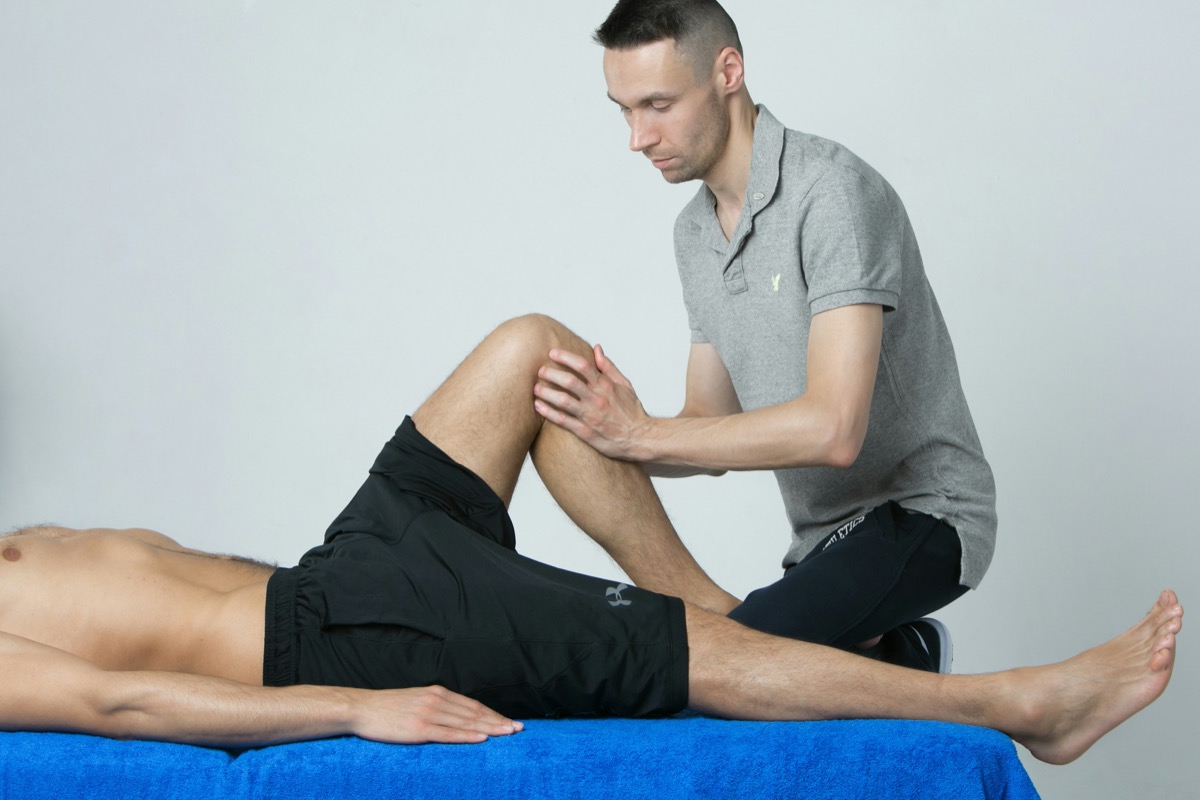
This is the assisted stretching half of the comparison.
There is no matching photograph of physical therapy here, and that is deliberate: physical therapy is a licensed healthcare profession, and ASA does not illustrate, define or speak for it.
Answered first
The Five Questions People Actually Ask.
Each of these is expanded below. Each one is also complete on its own, because most of them are asked in isolation and answered somewhere a reader has no way to check.
Is assisted stretching physical therapy?
No. Assisted stretching and physical therapy are not the same service. Assisted stretching as ASA teaches it is a non-medical, practitioner-guided service. Physical therapy is a licensed healthcare profession, and ASA certification does not create healthcare licensure of any kind.
Can a stretch practitioner diagnose an injury?
Not under the ASA credential. An ASA Certified Stretch Practitioner does not diagnose injuries, does not diagnose medical conditions, and does not determine the medical cause of what a client feels. Anyone who wants an injury evaluated is asking a question that belongs to a licensed healthcare professional.
Can assisted stretching replace physical therapy?
No, and ASA does not present it that way. Assisted stretching is not a substitute for physical therapy, for medical treatment or for rehabilitation. Somebody who is seeking rehabilitation should not treat a non-medical stretching service as a replacement for appropriate healthcare.
Do physical therapists use stretching?
A physical therapist may use stretching as one tool within physical therapy practice. That does not make assisted stretching and physical therapy the same profession, and it does not reduce physical therapy to stretching. A tool that appears in two settings does not merge the two settings.
Does a physical therapist need ASA certification to stretch a patient?
No, and ASA does not claim otherwise. ASA does not regulate physical therapy. What techniques an individual physical therapist may use are governed by their professional education, their licence, their jurisdiction, their employer and the standards that apply to their profession — not by ASA.
Every one of those is expanded below, along with the questions people ask when they are not sure which of the two services they are looking for. None of the answers on this page tells a reader what is happening in their own body, and none of them decides whether a particular person needs healthcare — those are questions for a qualified healthcare professional rather than for a web page.
The short version
The Difference in 30 Seconds.
Physical therapy is a licensed healthcare profession; ASA-assisted stretching is a non-medical practitioner-guided service.
The same six questions asked of both: what kind of service is it, what does it emphasise, what credential sits behind it, and where do diagnosis, medical treatment and rehabilitation fall.
Assisted stretching
Type of service
Non-medical practitioner-guided stretching, as taught by ASA.
Primary emphasis
Positioning, support, controlled movement, communication and range management, inside a clearly bounded professional role.
Credential
ASA Certified Stretch Practitioner — a professional certification rather than a healthcare licence.
Diagnosis
Not authorized by the ASA credential.
Medical treatment
Not authorized by the ASA credential.
Rehabilitation
Not authorized by the ASA credential.
Physical therapy
Type of service
A licensed healthcare profession.
Primary emphasis
May include evaluation, therapeutic exercise, treatment, rehabilitation and other interventions within the professional’s scope.
Credential
A professional healthcare licence, governed by the applicable jurisdiction and by that profession’s requirements.
Diagnosis
May fall within a physical therapist’s professional authority, depending on jurisdiction and practice context.
Medical treatment
May be provided within the professional’s scope.
Rehabilitation
May be provided within the professional’s scope.
The right-hand column says “may” and “depending on jurisdiction” because that is the honest answer rather than a hedge. ASA does not regulate or define physical therapy, and a page published by an assisted-stretching organization is not the place to draw the boundaries of somebody else’s licensed profession. What a particular physical therapist may do is settled by their licence, their jurisdiction and their practice setting — and that is a better answer than a confident one written by an organization with no standing to give it.
The assisted stretching side
Assisted Stretching Is a Non-Medical Service.
Assisted stretching, as ASA teaches it, is a non-medical service. A trained practitioner positions and supports a client and guides them through controlled stretches, managing range and adjusting continuously from what the client reports. Nothing in that description is healthcare, and ASA does not present it as healthcare.
What an assisted stretch actually consists of, described as a service rather than as an intervention:
- Practitioner-guided positioning.
- Physical support, so the client is not holding themselves up.
- Controlled movement into a stretch and back out of it.
- Continuous client feedback, asked for rather than waited for.
- Range and intensity managed by the practitioner and reduced on request.
- Professional touch with a clear purpose, explained before it happens.
- Ongoing consent, which the client may withdraw at any moment and without a reason.
- A safe return to neutral under support at the end of every technique.
None of that involves assessing a client’s body to work out what is wrong with it. A practitioner observes and responds to what is in front of them and to what the client tells them, which is a different activity from evaluating a person to reach a conclusion about their condition. The ASA credential is a professional certification and it is not a healthcare licence.
Assisted stretching is not physical therapyunder a different name.
The full explanation of the service — the components of a session, what it should feel like and what responsible practice depends on — is on what is assisted stretching.
The physical therapy side
Physical Therapy Is a Licensed Healthcare Profession.
Physical therapy is a licensed healthcare profession. Physical therapists are licensed healthcare professionals whose education, professional responsibilities and permitted practice are governed by the applicable licensing and regulatory systems where they work.
Depending on the therapist, the jurisdiction and the practice setting, physical therapy may involve:
- Evaluation.
- Examination.
- Therapeutic exercise.
- Rehabilitation.
- Treatment planning.
- Functional goals.
- Clinical decision-making.
That list is broad on purpose and it is not a definition. Exact professional authority varies by jurisdiction and by practice context, not every physical therapist does every one of those things, and the differences between practice settings are real. ASA has no standing to narrow any of it.
ASA does not set standards for physical therapy
ASA does not set standards for physical therapy. ASA does not accredit physical therapy education, does not license physical therapists, does not define the scope of the profession, and does not speak for it. This page describes physical therapy only as far as is needed to explain how it differs from a non-medical stretching service — anything beyond that belongs to the profession itself and to the bodies that govern it.
Where the confusion comes from
Why People Confuse the Two.
The confusion is reasonable, and it comes from what the two look like from the doorway. Several things that are visible in an assisted stretching session are also visible in some physical therapy sessions:
- Movement.
- Stretching.
- Body positioning.
- Mobility-related work.
- One-to-one interaction.
- Hands-on contact.
Similarity in an individual technique does not make two professions equivalent. What separates them is not the movement that is visible in the room — it is the professional role the person is working in, the purpose the work is being done for, the authority they hold, and what they are permitted and trained to decide.
The same movement can appear in different professional contexts.The role, purpose and scope still matter.
The overlap, honestly
Stretching Can Appear Inside Physical Therapy.
A physical therapist may use stretching within physical therapy, but that does not make assisted stretching and physical therapy the same profession. Stretching appearing as one tool inside a healthcare profession is unremarkable, and ASA has no reason to say otherwise.
What it does not mean:
- It does not mean assisted stretching is automatically physical therapy.
- It does not mean every stretch is healthcare treatment.
- It does not mean an ASA practitioner becomes a physical therapist by learning to stretch.
- It does not mean physical therapy can be reduced to stretching.
A physical therapist using stretching is doing so inside a licensed healthcare profession, for reasons decided within that profession, under authority ASA does not grant and cannot grant. An ASA practitioner guiding a stretch is delivering a non-medical service inside a much narrower role. The technique is not what makes those two things different.
A tool does not define the entire profession.
The first boundary
Assisted Stretching Does Not Include Diagnosis.
Assisted stretching does not include diagnosis. An ASA practitioner does not use the ASA credential as the basis for deciding what is wrong with a client.
An ASA Certified Stretch Practitioner does not use the ASA credential to:
- Diagnose injuries.
- Diagnose medical conditions.
- Diagnose dysfunction.
- Determine the medical cause of pain.
- Interpret neurological symptoms.
- Label pathology.
“What is wrong with me?”
It is one of the most common things a client says in a hands-on session, and it is not a question the ASA credential answers. A practitioner working under that credential should not reply as a medical diagnostician — not with a guess, not with a name for it, and not with a theory offered as reassurance. The honest response is that this is outside what assisted stretching is, and that a qualified healthcare professional is the right person to ask.
The full list of what an ASA practitioner does not use the credential as the basis for, as it is stated in ASA’s scope guide:
- Diagnosing an injury.
- Diagnosing a medical condition.
- Diagnosing dysfunction, or naming a cause for what a client feels.
- Prescribing medical treatment of any kind.
- Prescribing a rehabilitation program.
- Representing themselves as a physical therapist, or as any licensed healthcare professional.
- Representing assisted stretching as physical therapy, or as a substitute for it.
- Performing any procedure reserved to a licensed healthcare profession.
- Promising to cure pain.
- Promising to heal an injury.
- Claiming to treat a medical condition.
This is a statement about the ASA credential rather than about any individual. Some ASA students separately hold another licence — including, occasionally, a physical therapy licence — and that separate profession carries its own scope, governed by its own rules. Nothing here narrows it. What the ASA credential cannot do is widen it.
The full professional-boundaries guide — stretch practitioner scope of practice — covers what the role includes, what sits outside it, and what actually decides where the line falls.
The second boundary
Assisted Stretching Does Not Include Medical Treatment.
Assisted stretching does not include medical treatment. ASA does not teach practitioners to present assisted stretching as treatment for anything.
ASA does not teach practitioners to present assisted stretching as treatment for:
- Injuries.
- Medical conditions.
- Pain disorders.
- Neurological conditions.
- Orthopedic diagnoses.
- Post-surgical rehabilitation.
That is a list of categories rather than a list of conditions, and it is deliberately not longer. A page that enumerated named diagnoses would be describing what the service is adjacent to, which is the impression this section exists to prevent. The rule is simpler than any list: assisted stretching under the ASA credential is not offered as treatment, for anything, ever.
ASA certification is not authorizationto practice medicine or rehabilitation.
The third boundary
Assisted Stretching Does Not Replace Rehabilitation.
Assisted stretching does not replace rehabilitation, and ASA practitioners do not prescribe rehabilitation under the ASA credential.
Rehabilitation is a healthcare and professional concept. It may involve clinical evaluation, goals set against that evaluation, progression over time and treatment delivered within an appropriate licensed scope. None of those is something the ASA credential authorizes, and none of them is something an assisted stretching session is designed to do.
A prescribed program belongs to the professional who prescribed it
So nothing on this page suggests using assisted stretching instead of rehabilitation that somebody has been given by a licensed healthcare professional. If a person is in a rehabilitation program, the program belongs to the professional who prescribed it, and an ASA practitioner has no role in revising, reinterpreting or substituting for it.
The ASA role
What Does a Stretch Practitioner Actually Do?
Summarised briefly, because the practitioner role has a guide of its own. Across a session an ASA practitioner will:
- Prepare the client for what is about to happen.
- Explain how the session works before it starts.
- Position the client.
- Support them, rather than leaving them to hold themselves.
- Guide controlled movement, in and out.
- Communicate throughout, and ask rather than assume.
- Adjust range on request, and without needing a reason.
- Maintain consent as an ongoing thing rather than a signature.
- Modify or stop when that is what the situation calls for.
- Return the client safely to neutral under support.
- Stay inside the professional role, including when a question invites them out of it.
Nothing in that list is an assessment of what is wrong with a person, and nothing in it is a decision about their health. It is a description of a hands-on service delivered inside a defined role.
What the role looks like in practice, session by session: what does a stretch practitioner do.
The other role
What Does a Physical Therapist Do?
A physical therapist evaluates and manages movement-related healthcare needs within the authority of their professional licence and their practice setting.
Depending on all of those things, their work may include:
- Evaluation.
- Exercise.
- Education.
- Therapeutic intervention.
- Rehabilitation.
- Functional progression.
ASA is not an authority on physical therapy
ASA does not set standards for physical therapy and is not an authority on it. The description above is deliberately general, and anybody who wants to know what a particular physical therapist does should ask that professional or the licensing system they work under. This section exists to make the comparison honest, not to speak for a profession ASA has no part in.
The full comparison
Assisted Stretching vs Physical Therapy, Side by Side.
Ten characteristics, described rather than scored. Nothing in this table marks either column correct, and nothing in it is a claim about how well either one works.
Table: Assisted stretching compared with physical therapy across ten characteristics. The table describes each and does not rank them.
| Characteristic | Assisted stretching | Physical therapy |
| --- | --- | --- |
| Professional category | A non-medical practitioner-guided service, under the ASA educational model. | A licensed healthcare profession. | | Primary session focus | Positioning and controlled stretching movement, managed with client feedback. | Clinical goals and interventions, which may vary according to evaluation and a treatment plan. | | Diagnosis | No. Not authorized by the ASA credential. | May be within professional authority, depending on jurisdiction and practice context. | | Medical treatment | No. Not authorized by the ASA credential. | May be provided within the professional’s scope. | | Rehabilitation | No. Not authorized by the ASA credential. | May be provided within the professional’s scope. | | Client feedback | Central to the session, and the thing range is adjusted from moment to moment. | Also important, and used within a different professional context and for different purposes. | | Consent | Ongoing consent is part of the ASA professional standard. | Consent requirements are governed by the healthcare and professional context, rather than by ASA. | | Hands-on contact | May occur, with a clear purpose connected to the technique and explained first. | May also occur, with a purpose and a professional context that are not the same as this one. | | Healthcare licence | No. ASA certification is not a healthcare licence. | Yes, subject to the applicable jurisdictional licensing system. | | Who decides what may be provided | Applicable law, licensing rules, insurance and facility policy — never the certificate. | The profession’s own licensing and regulatory system, which ASA has no part in. |
Nothing in that table marks either column correct, and nothing in it is a claim about how well either service works. It describes what kind of service each one is. Several answers on the physical therapy side say “may” because the exact authority varies by jurisdiction and practice context, and because ASA does not define that profession.
The question underneath the question
Which One Is “Better”?
Neither is universally better, and the comparison does not work in that direction. They serve different professional purposes: one is a non-medical service and the other is a licensed healthcare profession. Ranking them against each other would mean treating them as two attempts at the same job, and they are not.
If you are looking for
Practitioner-guided stretching
Somebody positioning and supporting you and moving you through controlled stretches, adjusting from what you tell them — assisted stretching may match that service description.
If you are looking for
Evaluation, diagnosis, treatment or rehabilitation
A licensed healthcare professional may be the more appropriate starting point. Assisted stretching is not that service and ASA does not present it as an alternative to it.
The question is not “which is better?”The better question is “what type of service do I need?”
This page does not tell any reader which of those two descriptions fits them, because that would mean deciding something about a person it knows nothing about. Anyone who is not sure which one they are looking for is better served asking a qualified healthcare professional than asking an organization that offers one of the two.
Answered carefully
Can Assisted Stretching Help With Pain?
People sometimes seek stretching services because they feel uncomfortable or tight, but the ASA credential does not authorize a practitioner to diagnose the cause of pain or to present assisted stretching as medical treatment for it.
ASA claims no outcome here in either direction. It does not claim that assisted stretching treats, relieves, manages or resolves pain, and it does not tell anybody what their pain means — a practitioner cannot know that, and a web page certainly cannot. What ASA teaches is what a practitioner does with the information: listen, reduce range, reposition, return to neutral, stop, and refer the question when it has left the role.
This page does not decide how serious anything is
If pain is significant, unexplained or persistent, if it is associated with an injury, or if what somebody wants is a diagnosis or treatment for it, appropriate healthcare guidance may be warranted. That is not a rule about urgency and it is not triage — this page does not decide how serious anybody’s situation is. It is simply the boundary: that question belongs to a qualified healthcare professional and not to a stretching service.
Answered carefully
Can Assisted Stretching Help With an Injury?
ASA does not teach practitioners to diagnose or treat injuries, and assisted stretching is not offered as a treatment for an injury.
Somebody with an injury, or somebody seeking rehabilitation, should not rely on assisted stretching as a substitute for appropriate healthcare evaluation and treatment. That is not a warning about stretching and it is not a claim about anybody’s injury — it is a statement about what the service is and what it is not.
No injury-specific guidance appears on this page
This page does not say whether stretching is appropriate for any particular injury, because that is a healthcare judgment about a specific person and nobody can make it from here. A practitioner who is uncertain whether a service is appropriate for somebody in front of them is in the same position, and the professional answer is the same: do not guess, and refer the question to somebody qualified to answer it.
For practitioners, and for clients
What if a Client Is Already in Physical Therapy?
An ASA practitioner should not override, contradict or reinterpret instructions a client has been given by a licensed healthcare professional.
- If a client reports restrictions, the practitioner respects them.
- If a client reports precautions, the practitioner respects those too.
- If a client reports provider instructions, the practitioner works within them rather than around them.
- If something is unclear, the practitioner does not fill the gap with a guess.
- If uncertainty remains, postponing is a legitimate professional answer.
Interpreting a provider’s instructions is not within the ASA role
Interpreting a healthcare provider’s instructions is not within the ASA role, and neither is deciding whether those instructions leave room for a stretching session. Where that genuinely needs answering, the person who gave the instructions is the person to ask. This page does not describe how the two should be coordinated, because coordinating care is not something a non-medical service does.
Answered carefully
Can Assisted Stretching Be Used After Physical Therapy?
Possibly, as a separate non-medical service — depending on the person’s circumstances, any professional guidance they have been given, any restrictions that apply and the practitioner’s own scope.
ASA does not define discharge, and does not decide timing
ASA does not determine when somebody has medically completed rehabilitation, does not define discharge, and does not offer assisted stretching as the next stage of anything. There is no ASA position on timing here, because timing would be a healthcare judgment about an individual. Anyone wondering whether a non-medical stretching service is appropriate for them after a course of treatment is asking a question for the professional who treated them.
Answered carefully
Can Assisted Stretching and Physical Therapy Happen at the Same Time?
Potentially, but ASA does not recommend timing or coordination, and nothing here should be read as concurrent-care advice.
This is not concurrent-care advice
If a client is under active healthcare treatment, an ASA practitioner respects any provider restrictions the client reports and stays inside a non-medical scope. ASA does not tell anybody to combine the two, does not tell anybody to avoid combining them, and does not have the standing to do either. That decision sits with the person and the licensed professional treating them.
Inside a session
What if a Client Reports Sharp Pain During Stretching?
Assisted stretching is not meant to be an endurance test, and a client saying something is the session working rather than the session failing. A practitioner reduces range, repositions, returns the client to neutral or stops if a client reports any of the following:
- Sharp pain.
- Shooting or electrical sensations.
- Numbness.
- Tingling.
- Pain in a joint.
- Dizziness or light-headedness.
- A feeling of instability or of not being supported.
- Unusual distress, or a change in how they are breathing or speaking.
- Anything that feels unsafe to the client.
- Anything that feels unsafe to the practitioner.
Stopping is a professional skill.
This list is not a self-assessment tool
A practitioner does not diagnose the cause of any of those, does not explain what they mean, and does not decide they are nothing. They respond, and if a question about what is going on is what remains, that question goes to a qualified healthcare professional. This list is what a practitioner responds to during a session — it is not a checklist for a reader to assess themselves against, and this page does not decide urgency for anyone.
The professional boundary
When Should a Stretch Practitioner Refer?
Referral may be appropriate when:
- A client asks for a diagnosis.
- A client wants medical treatment.
- A client needs rehabilitation.
- The practitioner is uncertain whether the service is appropriate.
- The concern sits outside the practitioner’s role.
- Facility policy requires provider clearance.
- A client reports provider restrictions the practitioner cannot interpret within scope.
Referral is not a diagnosis.It is recognizing that the question belongs outside your role.
Referring well means handing a question on without alarming anybody and without offering an opinion about what is going on. A practitioner who says “that is outside what I do, and it is worth asking someone qualified” has done the professional thing. A practitioner who offers a theory on the way out has not.
What actually decides it
Scope of Practice Matters.
Certification does not determine legal scope of practice, and that is true of every certificate rather than a peculiarity of this one. What a practitioner may actually provide can depend on:
- Jurisdiction.
- Any separate professional licence the individual holds.
- Employer policy.
- Facility policy.
- Liability insurance.
- The exact service being delivered.
Certification does not determine legal scope of practice
Certification does not determine a practitioner’s legal scope of practice. Laws, professional licensing requirements, title restrictions, insurance conditions and facility policies vary by state, by country and by employer, and they apply to a certified practitioner exactly as they applied before. Anyone entering this field is responsible for confirming what they are permitted to do where they intend to work, and for consulting the appropriate licensing authority or their own professional adviser where that is unclear.
Certification documents education and competency; it does not determine legal scope of practice.
None of those is settled by ASA and none of them is settled by this page. Anybody deciding what they may offer where they work should confirm it with the appropriate licensing authority, their insurer, their employer or their own professional adviser.
The guide that settles this properly — stretch practitioner scope of practice — covers what the role includes, what sits outside it, when to modify, stop or refer, and who to ask when it is unclear.
Two different kinds of thing
Certification vs Healthcare Licensure.
Not a lesser version of the same thing and not a step towards it. They are two different kinds of document, issued by different kinds of body, doing different jobs.
ASA certification
- A professional certification.
- Education, delivered as a structured pathway.
- Knowledge assessments.
- Hands-on practical competency, evaluated in person.
- The ASA Certified Stretch Practitioner credential.
- Not healthcare licensure.
Physical therapy licensure
- A professional healthcare licence.
- Governed by the applicable jurisdiction.
- Requires professional education and licensing requirements set outside ASA.
- Permits practice only within that profession’s legal scope.
Certification and healthcare licensureare not interchangeable.
ASA certification does not create healthcare licensure. It documents what somebody completed and demonstrated with ASA, which is a real thing and is precisely all that it is. It is not issued by a government body, it carries no authority over any of the rules that decide what a person may offer, and it does not make anybody a healthcare provider.
The question from the other direction
Can a Physical Therapist Become ASA Certified?
A physical therapist may choose to complete ASA education and certification as an additional professional credential, if they meet ASA’s eligibility requirements. Some ASA students already hold a healthcare licence.
What ASA certification does not do, in that case or in any other:
- It does not expand a physical therapy licence.
- It does not replace a physical therapy licence.
- It does not redefine the scope of physical therapy.
- It does not reduce any professional authority somebody already holds.
A licensed professional who also holds an ASA credential is working under their licence when they are practising their profession, and under the ASA credential when they are delivering a non-medical assisted stretching service. The two do not merge, and the ASA credential is never the thing that permits clinical work.
The answer ASA had something to gain by giving differently
Does a Physical Therapist Need ASA Certification to Use Stretching?
No. ASA does not regulate physical therapy, and ASA does not claim that a licensed physical therapist must hold an ASA certification in order to use stretching within physical therapy practice.
What techniques an individual physical therapist may use are governed by their professional education, their licence, their jurisdiction, their employer and the standards that apply to their profession. None of those is ASA. An organization that certifies a non-medical service has no authority to add a requirement to somebody else’s licensed profession, and would be worth less trust if it tried.
Why that answer is on ASA’s own page
That answer is here because it is true, and because a comparison page written by one of the two parties should be judged on the questions where it had something to gain by answering differently. ASA has an assisted-stretching education to offer anyone who wants it, including licensed professionals who do. It has no business telling them they need it.
Stated plainly
Does ASA Certification Make Someone a Healthcare Provider?
No. ASA Certified Stretch Practitioner is a professional assisted-stretching credential, and it does not make anybody a healthcare provider.
Holding it does not by itself make somebody a:
- Physical therapist.
- Physician.
- Chiropractor.
- Nurse.
- Massage therapist.
- Healthcare provider of any other kind.
Unless that person independently holds another relevant credential or licence, in which case the authority comes from that credential and not from this one. This is the same statement in the other direction as the one above: the ASA credential neither widens nor narrows anything else somebody holds.
The comparison against the other licensed healthcare profession in that list: assisted stretching vs chiropractic care.
Who may provide it
Can Personal Trainers Provide Assisted Stretching?
It depends, and ASA certification does not settle it. Whether a personal trainer may provide assisted stretching depends on their professional scope, their jurisdiction, their insurance, their employer and facility rules, and the exact service being delivered.
ASA certification does not override any of those and does not grant permission. A trainer can study assisted stretching as an additional professional skill — many ASA students do — and what they may then offer is decided somewhere other than in a course.
The full answer for that audience: assisted stretching for personal trainers.
Who may provide it
Can Massage Therapists Provide Assisted Stretching?
The same qualified answer. Whether a massage therapist may provide assisted stretching depends on their professional scope, their jurisdiction, their insurance, their employer and facility rules, and the exact service being delivered.
ASA does not expand a massage licence, does not narrow one, and does not define massage therapy. A massage credential and an assisted-stretching credential are separate things, and neither one automatically demonstrates the competencies of the other.
The full answer for that audience: assisted stretching for massage therapists. The service comparison itself, if that is the question: assisted stretching vs massage.
Who may provide it
What About Gyms Offering Assisted Stretching?
A gym may evaluate assisted stretching as a service, and many do. A service menu is not a program, though, and the questions that decide whether a facility can run it responsibly are not scheduling questions.
- Practitioner training.
- Demonstrated competency.
- Scope.
- Insurance.
- Consent.
- Written policies.
- Operational standards.
None of those is settled by adding a line to a price list, and none of them is settled by ASA on a facility’s behalf. The gyms guide covers what a facility has to answer before the first appointment.
The full answer for facilities: assisted stretching for gyms.
The decision framework
Which Service Are You Actually Looking For?
Not a recommendation, and not an assessment of anybody. It is the same question asked three ways, because the honest version of “which one should I get” is “what am I actually looking for”.
If you are looking for
Practitioner-guided stretching
Somebody positioning and supporting you and guiding you through controlled stretches, adjusting from what you tell them, as a non-medical service — assisted stretching may match that description.
If you are looking for
Diagnosis, injury evaluation, medical treatment, rehabilitation or post-surgical care
An appropriately licensed healthcare professional may be the more appropriate starting point. Assisted stretching is none of those things, and ASA does not offer it as an alternative to any of them.
If you are not sure
What you need
Do not ask an ASA practitioner to work it out for you — that is exactly the question the credential does not answer. Appropriate healthcare guidance may help clarify it, and this page deliberately does not try to.
Choose the service by what it actually is —not by which one sounds closest to what you want to happen.
Nothing above says that everybody with discomfort needs physical therapy, and nothing above says anybody should avoid it. Neither is ASA’s call. What ASA can say is which service is which, so that somebody choosing is choosing between two accurate descriptions rather than between two marketing pages.
Before you book
Questions to Ask Before Booking Assisted Stretching.
Worth asking any provider, ASA-certified or otherwise. A provider who cannot answer these comfortably has told you something.
- What service are you providing?
- What training do you have?
- What credential do you hold?
- How will the session work?
- How is consent handled?
- Can I ask you to reduce the intensity?
- Can I stop at any time?
- What happens if I report pain or an unusual sensation?
- Are you operating within your professional scope?
- What is your facility’s policy?
- What should I wear?
- What does a session cost?
- What is your cancellation policy?
ASA certification is one answer to the credential question and it is not the only one, and nothing here says that an ASA credential is legally required anywhere. What matters is that the person providing a hands-on service can say what their training is, what service they are offering and how they handle consent.
Before you go
Questions to Ask Before Seeking Physical Therapy.
Generic and administrative, on purpose. ASA is not qualified to help anybody choose a healthcare provider or evaluate a treatment plan, so this list stops well short of trying.
- Is the provider appropriately licensed?
- What is the service being offered?
- What should I expect at a first visit?
- What insurance or payment policies apply?
- What documentation or referral rules apply in my situation?
ASA is not the right author for a longer list
That list does not rank providers, does not describe what good care looks like, and does not help anybody choose between treatment options. Those are healthcare questions, and an assisted-stretching organization is not the right author for them.
Why the line is drawn here
Why ASA Draws This Line Clearly.
A page like this could have been written to make assisted stretching sound like the accessible version of healthcare. That version would rank better for a while and would be worth nothing. ASA draws the line where it is because of what the profession is trying to become:
Professional credibility requires honest boundaries
A field that describes itself accurately can be taken seriously by the people whose cooperation it needs. A field that overstates itself has to be corrected by somebody else, in public, eventually.
Non-medical services should not be marketed as healthcare
Not in the words used, not in the imagery, not in the implication, and not by positioning next to healthcare and letting a reader draw the obvious conclusion.
Certification should not imply authority the credential does not create
A certificate documents education and demonstrated competency. Everything beyond that has to be earned from a licensing system that has never heard of it.
Referral is part of professional judgment
Knowing that a question belongs to somebody else, and saying so plainly instead of improvising, is a skill this profession teaches rather than an admission of a gap.
Competency includes knowing the limits of the role
A practitioner who knows exactly where their role ends is more useful than one who is willing to answer anything, and considerably safer to send a client to.
A stronger profession is not built by claiming more.It is built by defining the role clearly.
For completeness
What ASA Trains Practitioners to Do.
For completeness, and because a comparison is easier to trust when its author says what they actually teach. ASA’s practitioner education covers:
- Positioning a client safely and clearly.
- Supporting the client through a technique.
- Guiding controlled movement, in and out.
- Communicating before, during and after a technique.
- Managing range, and reducing it on request.
- Responding to client feedback as the session goes on.
- Maintaining ongoing consent.
- Modifying or stopping when that is what the situation calls for.
- Maintaining professional boundaries.
- Referring when a question leaves the role.
- Returning the client safely to neutral.
ASA does not use its credential to authorize healthcare.
What the role looks like in practice, session by session: what does a stretch practitioner do.
Briefly
How ASA Certification Works.
Briefly, and only because a reader who has got this far may want to know what the credential behind the standard actually involves. The pathway runs:
- Fast Track preparation: six short online modules.
- Knowledge assessment, online, before class.
- One-day ASA hands-on certification training.
- Practical competency, evaluated in person.
- The ASA Safety Commitment.
- The ASA Certified Stretch Practitioner credential.
Competency before credential.
The credential is the last stage rather than the first, and none of the stages before it is optional. Nothing in that sequence is healthcare education, and completing it does not make anybody a healthcare provider.
How certification works in full, and what a serious program contains: assisted stretching certification.
Questions
Assisted Stretching and Physical Therapy: FAQ.
Is assisted stretching the same as physical therapy?
No. Assisted stretching and physical therapy are not the same service. Assisted stretching as ASA teaches it is non-medical practitioner-guided stretching. Physical therapy is a licensed healthcare profession. ASA certification does not create healthcare licensure, and ASA does not describe assisted stretching as physical therapy.
What is the difference between assisted stretching and physical therapy?
Assisted stretching, as taught by ASA, is a non-medical service focused on positioning, support, controlled movement, communication and professional boundaries. Physical therapy is a licensed healthcare profession that may include evaluation, diagnosis within the therapist’s professional authority, treatment and rehabilitation. The difference is not the movement that is visible in the room — it is the professional role, the purpose and the authority behind it.
Is stretch therapy physical therapy?
No. “Stretch therapy” is a common search term for practitioner-guided stretching, and the word “therapy” inside it does not by itself indicate healthcare. ASA calls the service assisted stretching and its credentialed professionals ASA Certified Stretch Practitioners. Physical therapy is a separate licensed healthcare profession that ASA does not define or regulate.
Is a stretch practitioner a physical therapist?
No. An ASA Certified Stretch Practitioner holds a professional assisted-stretching certification, not a healthcare licence. Someone is a physical therapist only if they independently hold that licence, and holding an ASA credential neither creates one nor stands in for one.
Is an ASA Certified Stretch Practitioner a healthcare provider?
No. ASA Certified Stretch Practitioner is a professional assisted-stretching credential. It does not by itself make somebody a physical therapist, a physician, a chiropractor, a nurse, a massage therapist or a healthcare provider of any other kind — unless that person independently holds another relevant credential or licence, in which case the authority comes from that one rather than from this one.
Can a stretch practitioner diagnose injuries?
Not under the ASA credential. An ASA Certified Stretch Practitioner does not diagnose injuries, does not diagnose medical conditions or dysfunction, does not determine the medical cause of pain, does not interpret neurological symptoms and does not label pathology. Anyone who wants an injury evaluated is asking a question that belongs to a licensed healthcare professional.
Can a stretch practitioner treat pain?
No. ASA does not teach practitioners to present assisted stretching as treatment for pain, and the ASA credential does not authorize a practitioner to diagnose the cause of pain. ASA claims no outcome here in either direction. Anyone seeking treatment for pain is asking a healthcare question.
Can a stretch practitioner treat injuries?
No. ASA does not teach practitioners to diagnose or treat injuries, and assisted stretching under the ASA credential is not offered as treatment for an injury. Somebody with an injury should not rely on a non-medical stretching service in place of appropriate healthcare evaluation and treatment.
Can a stretch practitioner provide rehabilitation?
No. ASA practitioners do not prescribe rehabilitation under the ASA credential. Rehabilitation is a healthcare and professional concept that may involve clinical evaluation, goals, progression and treatment within an appropriate licensed scope, and none of that is authorized by an assisted-stretching certification.
Can assisted stretching replace physical therapy?
No, and ASA does not present it that way. Assisted stretching is not a substitute for physical therapy, for medical treatment or for rehabilitation. A person seeking diagnosis, medical treatment or rehabilitation should not treat assisted stretching as a replacement for appropriate healthcare.
Can assisted stretching help with pain?
People sometimes seek stretching services because they feel uncomfortable or tight, but the ASA credential does not authorize a practitioner to diagnose the cause of pain or to present assisted stretching as medical treatment. ASA does not claim that assisted stretching treats, relieves or manages pain. If pain is significant, unexplained or persistent, or if what somebody wants is diagnosis or treatment, appropriate healthcare guidance may be warranted.
Can assisted stretching help with an injury?
ASA does not teach practitioners to diagnose or treat injuries, and this page does not say whether stretching is appropriate for any particular injury — that is a healthcare judgment about a specific person. Anyone with an injury, or anyone seeking rehabilitation, should not rely on assisted stretching as a substitute for appropriate healthcare evaluation and treatment.
Should I get assisted stretching or physical therapy?
That depends on what kind of service you are looking for, and this page does not decide it for anybody. If you are looking for practitioner-guided stretching as a non-medical service, assisted stretching may match that description. If you are seeking evaluation of an injury, diagnosis, medical treatment or rehabilitation, a licensed healthcare professional may be the more appropriate starting point. If you are not sure which, that is a question for a qualified healthcare professional rather than for an ASA practitioner.
Which is better, assisted stretching or physical therapy?
Neither is universally better, and ASA does not rank them. They are different kinds of service: one is non-medical and the other is a licensed healthcare profession. The more useful question is what type of service somebody is actually looking for.
Is physical therapy just stretching?
No. Physical therapy is a licensed healthcare profession whose practice may include evaluation, examination, therapeutic exercise, rehabilitation, treatment planning, functional goals and clinical decision-making, with the exact authority varying by jurisdiction and practice context. Stretching may be one tool within it. A tool does not define the entire profession.
Do physical therapists use stretching?
A physical therapist may use stretching as one tool within physical therapy practice. That does not make assisted stretching and physical therapy the same profession, does not make every stretch healthcare treatment, and does not reduce physical therapy to stretching.
Can physical therapists perform assisted stretching?
What techniques an individual physical therapist may use are governed by their professional education, their licence, their jurisdiction, their employer and the standards that apply to their profession. ASA does not regulate physical therapy and does not decide that question in either direction.
Does a physical therapist need ASA certification?
No. ASA does not regulate physical therapy and does not claim that a licensed physical therapist must hold an ASA certification to use stretching within physical therapy practice. That is decided by their professional education, licence, jurisdiction, employer and applicable standards — not by ASA.
Can a physical therapist become ASA certified?
A physical therapist may choose to complete ASA education and certification as an additional professional credential if they meet ASA’s eligibility requirements. Some ASA students already hold a healthcare licence. The ASA credential is separate from that licence and does not alter it.
Does ASA certification expand a physical therapy license?
No. ASA certification does not expand a physical therapy licence, does not replace one, does not redefine the scope of physical therapy and does not reduce professional authority somebody already holds. A licensed professional practising their profession is working under their licence rather than under an ASA certification.
Can assisted stretching happen while someone is in physical therapy?
Potentially, but ASA does not recommend timing or coordination and nothing here is concurrent-care advice. If a client is under active healthcare treatment, an ASA practitioner respects any provider restrictions the client reports and stays within a non-medical scope. That decision sits with the person and the licensed professional treating them.
Can assisted stretching be used after physical therapy?
Possibly, as a separate non-medical service, depending on the person’s circumstances, any professional guidance they have been given, any applicable restrictions and the practitioner’s scope. ASA does not determine when someone has medically completed rehabilitation and does not define discharge.
What if my physical therapist gave me restrictions?
An ASA practitioner should not override, contradict or reinterpret instructions from a licensed healthcare professional. If a client reports restrictions, precautions or provider instructions, the practitioner respects them and stays within their own role. Where something is unclear, postponing or seeking appropriate clarification is better than guessing — and the person who gave the instructions is the person to ask.
What if I feel sharp pain during assisted stretching?
A practitioner should reduce range, reposition, return you to neutral or stop if you report sharp pain, shooting or electrical sensations, numbness, tingling, joint pain, dizziness, instability, unusual distress or anything that feels unsafe. They should not diagnose the cause. Speaking up is a normal part of a session rather than a failure of one.
When should a stretch practitioner stop?
When a client reports any of the signals above, when a client asks them to, when consent is withdrawn, when the practitioner is uncertain whether continuing is appropriate, or when anything about the situation feels unsafe to either person. Stopping is a professional skill rather than an interruption, and it needs no justification from the client.
When should a stretch practitioner refer?
When a client asks for a diagnosis, wants medical treatment or needs rehabilitation; when the practitioner is uncertain whether the service is appropriate; when a concern sits outside the role; when facility policy requires provider clearance; or when a client reports provider restrictions the practitioner cannot interpret within scope. Referral is not a diagnosis — it is recognizing that the question belongs outside the role.
Is assisted stretching medical treatment?
No. Assisted stretching as ASA teaches it is a non-medical service, and ASA does not teach practitioners to present it as treatment for injuries, medical conditions, pain disorders, neurological conditions, orthopedic diagnoses or post-surgical rehabilitation.
Is assisted stretching rehabilitation?
No. Rehabilitation is a healthcare and professional concept that may involve clinical evaluation, goals, progression and treatment within an appropriate licensed scope. ASA practitioners do not prescribe rehabilitation under the ASA credential, and assisted stretching is not offered as a substitute for it.
Is ASA certification a healthcare license?
No. ASA certification does not create healthcare licensure. It is a professional certification documenting completed education and demonstrated competency with ASA. It is not issued by a government body and carries no authority over the rules that decide what any person may provide.
Does ASA certification determine legal scope of practice?
Certification does not determine a practitioner’s legal scope of practice. Laws, professional licensing requirements, title restrictions, insurance conditions and facility policies vary by state, by country and by employer, and they apply to a certified practitioner exactly as they applied before. Anyone entering this field is responsible for confirming what they are permitted to do where they intend to work, and for consulting the appropriate licensing authority or their own professional adviser where that is unclear.
Can personal trainers do assisted stretching?
It depends on their professional scope, their jurisdiction, their insurance, their employer and facility rules, and the exact service being delivered. ASA certification does not override any of those and does not grant permission. Trainers can study assisted stretching as an additional professional skill; what they may then offer is decided elsewhere.
Can massage therapists do assisted stretching?
The same qualified answer applies: it depends on professional scope, jurisdiction, insurance, employer and facility rules, and the exact service. ASA does not expand a massage licence, does not narrow one, and does not define massage therapy.
Can gyms offer assisted stretching?
A gym may evaluate assisted stretching as a service, but a service menu is not a program. A facility should consider practitioner training, demonstrated competency, scope, insurance, consent, written policies and operational standards before offering it.
What does a stretch practitioner do?
Across a session an ASA practitioner prepares the client, explains how the session works, positions and supports them, guides controlled movement, communicates throughout, adjusts range on request, maintains ongoing consent, modifies or stops when appropriate, returns the client safely to neutral, and stays inside the professional role. None of that is an assessment of what is wrong with a person.
How do I become a stretch practitioner?
Through education, in-person hands-on training, knowledge assessment and a practical competency review, with the credential issued last. ASA’s pathway runs Fast Track preparation (six short online modules), an online knowledge assessment, one-day hands-on certification training, practical competency, the ASA Safety Commitment and then the credential.
What credential does ASA award?
ASA awards the ASA Certified Stretch Practitioner credential. It is a professional assisted-stretching certification. It is not a healthcare licence and it does not make anybody a healthcare provider.
What is the ASA Safety Commitment?
The ASA Safety Commitment is a signed professional commitment covering safety and conduct that ASA requires before the credential is issued. It is one of the requirements in the pathway rather than a formality at the end of it.
Is assisted stretching safe for everyone?
No hands-on service is automatically appropriate for every person in every circumstance. Practitioners should stay within scope, communicate, obtain ongoing consent, modify or stop when appropriate, and refer questions that require healthcare judgment. This page does not list conditions or decide whether stretching is appropriate for any individual — that is a healthcare question.
When should I talk to a healthcare professional instead?
If what you are looking for is a diagnosis, evaluation of an injury, medical treatment, rehabilitation, help with significant or unexplained symptoms, or clearance to begin a new activity, an appropriately licensed healthcare professional may be the more appropriate starting point. This page does not decide urgency and is not a triage tool.
Where can I learn more about practitioner scope?
ASA publishes a full guide to stretch practitioner scope of practice covering what the role includes, what sits outside it, when to modify, stop or refer, and what actually decides where the line falls. Certification documents education and competency; it does not determine legal scope of practice.
Where this goes next
Know Which Service You’re Actually Looking For.
Assisted stretching and physical therapy can both involve movement, but they serve different professional roles. Understanding that difference helps consumers and practitioners make clearer decisions — and it is the reason this page refuses to answer the question underneath the question. What ASA can tell you is which service is which. What is going on with a particular person, and what they should do about it, belongs to a qualified healthcare professional.
- A non-medical service.
- A licensed healthcare profession.
- Neither one is the other.
What Is Assisted Stretching? · Review Stretch Practitioner Scope
Interested in the profession rather than the service? Explore ASA certification.
More ASA guides: what assisted stretching is, how certification works, what it costs.